
What Happens the Moment You Press Submit

Every time you fill out a form, click a button, or log into an account on the web, a data exchange occurs between your browser and a remote server. This exchange process is completely transparent during normal use; all you see is the page loading and responding. However, hidden within this invisible transmission process are the core components of the website's security architecture. How data is packaged, how authentication mechanisms work, and how the server verifies your identity—these details determine whether a website is truly secure or merely appears to be secure. Burp Suite allows cybersecurity professionals to stand between the browser and the server, intercepting all these transmission processes for detailed examination.

The Core Operational Logic of Burp Suite

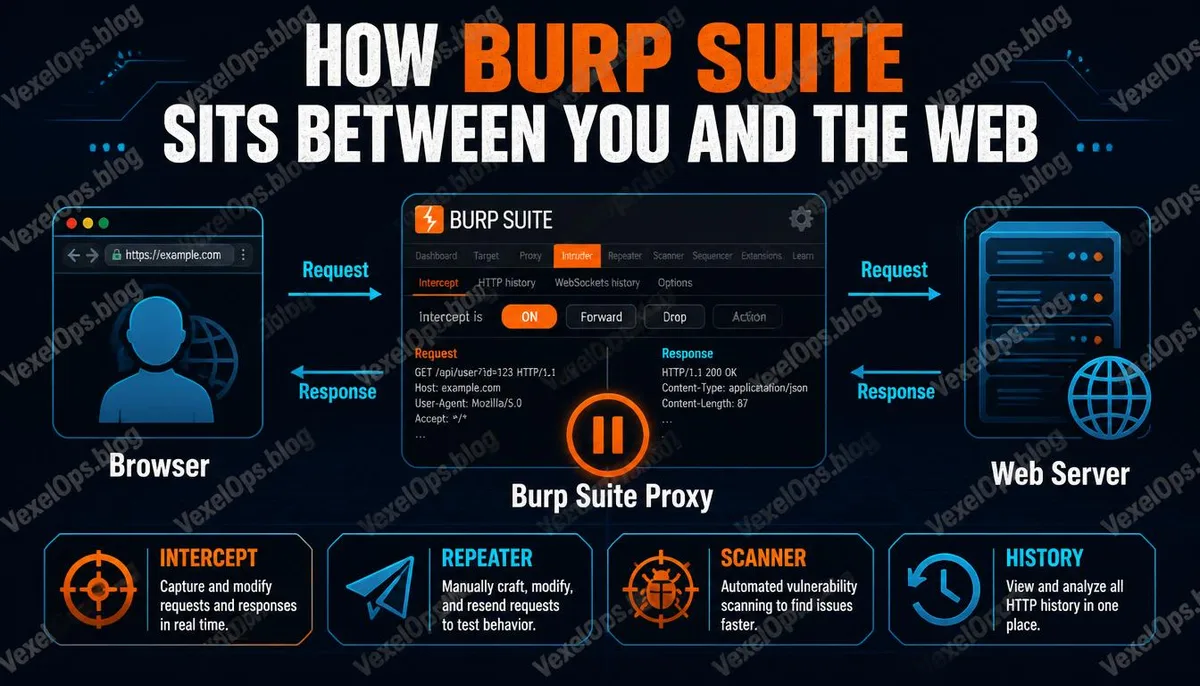
Burp Suite functions by positioning itself as a proxy server between the browser and the server. When your browser is configured to use Burp Suite as a proxy for browsing the internet, all HTTP and HTTPS traffic passes through Burp Suite before reaching its destination. This enables cybersecurity professionals to achieve several crucial tasks: Intercepting and Modifying Requests Before a request is sent to the server, Burp Suite can pause that request, allowing testers to view and modify any parameters. This function is used to test whether the server sufficiently validates input data, such as modifying a product's price parameter to see if the server accepts unreasonable values. Historical Record Analysis All traffic passing through Burp Suite is logged, enabling testers to review the complete content of any request and response without missing any details. Automated Scanning The professional version of Burp Suite includes automated vulnerability scanning capabilities, allowing for systematic security testing of target websites, including detection of common vulnerabilities like SQL Injection and XSS (Cross-Site Scripting).

In What Scenarios Do Cybersecurity Professionals Use It?

In authorized penetration testing work, Burp Suite is almost a standard tool. When a company commissions a cybersecurity firm to assess the security of its web applications, testers systematically check every functional module using Burp Suite, searching for potential vulnerabilities that could be exploited by attackers. In addition to commissioned penetration tests, Burp Suite is also widely used in: - Vulnerability Reward Programs: Many large tech companies, including Google, Meta, and Apple, have vulnerability reward programs that encourage security researchers to responsibly report discovered vulnerabilities. Burp Suite is among the most commonly used tools in this research work. - CTF Competitions: In Capture The Flag (CTF) competitions in the cybersecurity field, web security challenges almost always require the use of Burp Suite functionalities. - Cybersecurity Education: For learners aiming to enter the cybersecurity field, Burp Suite is the most direct practical tool for understanding the logic of web security defense and attack.

Burp Suite proxy server intercepting traffic operation principle explanatory infographic.

Differences Between Free and Professional Versions

Burp Suite offers a free community version that includes core functionalities such as proxy interception, historical records, and basic re-sending tests, which is sufficient for novice learning and basic testing. The professional version adds an automated scanning engine, advanced fuzz testing features, more complete vulnerability detection modules, and collaboration features, primarily aimed at professional penetration testers and corporate cybersecurity teams. For those just starting in web security, the functionalities provided in the community version are already adequate for extensive learning and practical exercises.

Boundaries to Understand Before Using Burp Suite

Burp Suite is a powerful testing tool, but its use has specific prerequisites: testing must be conducted on authorized targets. Testing within one's own established environment, participating under the scope of vulnerability reward programs, or testing on systems with explicit authorization are all legitimate use cases. Using Burp Suite to test or intercept any online system without authorization, in most regions, constitutes legal issues of unauthorized access, irrespective of the nature of the tool itself. Understanding the tool's capabilities and the boundaries of its use is equally important in cybersecurity learning.

Common Questions About Burp Suite

Can I Learn Burp Suite Without Any Programming Background?

You can get started, but some foundational knowledge is needed as a prerequisite. Understanding the basic structure of HTTP requests and responses, knowing what GET and POST requests are, and having a basic concept of how web forms function—none of this requires programming skills, but having this background will significantly speed up your understanding of how to use Burp Suite. There is a wealth of beginner resources online for learning Burp Suite, and PortSwigger also offers a free Web Security Academy course, which includes numerous interactive lab environments that can be practiced directly in the browser.

What Are the Differences Between Burp Suite and Wireshark?

Both are tools for analyzing network traffic, but they operate at different levels. Wireshark works at the network packet layer, allowing observation of all types of network traffic, including TCP, UDP, DNS, and various protocols, making it suitable for analyzing overall network behavior. On the other hand, Burp Suite focuses on the application layer of HTTP and HTTPS, conducting in-depth analysis and testing of web applications, making it more direct for web security testing. The two tools serve different analysis needs and hold their own distinct places in cybersecurity practice.

Do I Need to Worry About Legal Issues When Testing My Own Hosted Website on My Computer?

Conducting tests in a local environment or on a testing server you control does not involve unauthorized access issues and is a completely legal way to learn. Many cybersecurity learners intentionally set up practice environments that include vulnerabilities, such as DVWA or WebGoat, and use Burp Suite for practical exercises; this is widely recognized as a legitimate entry point into learning.

One Key Takeaway: Burp Suite allows security personnel to stand between the browser and the server for the first time, clearly seeing all the details of data transmission beneath the surface, and this perspective is the core starting point for identifying web security vulnerabilities.