
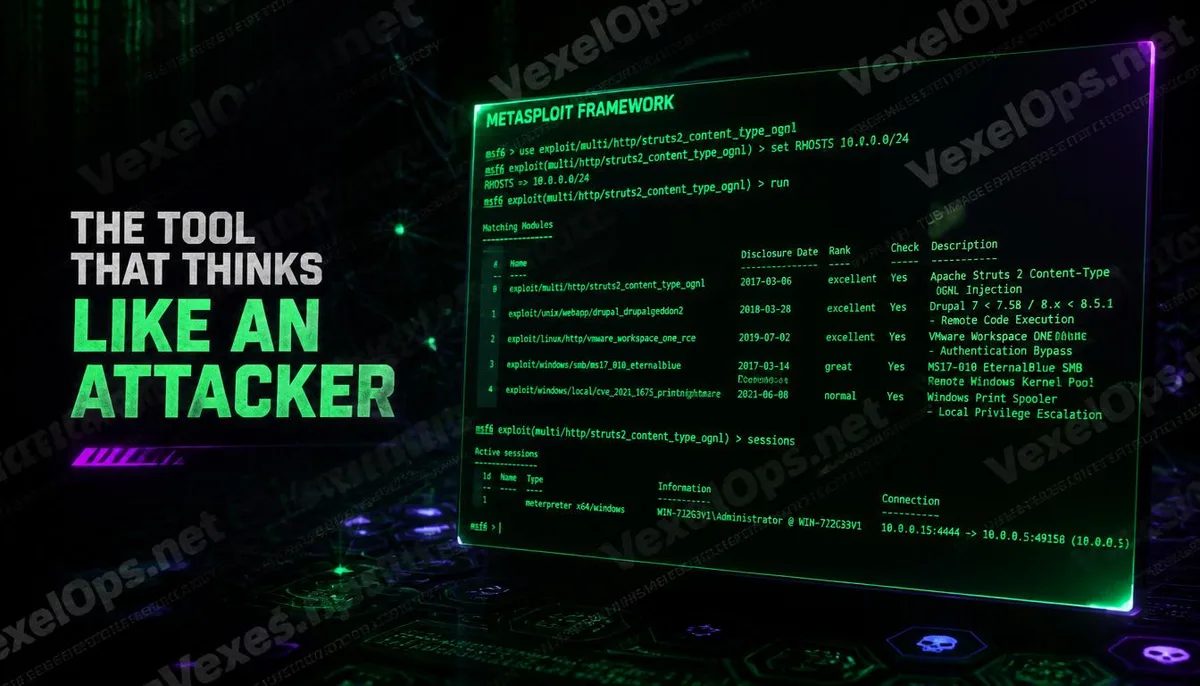
Find It Before Attackers Do
Information security has a core logical contradiction: to protect a system, one must first understand how it can be compromised. This logic gave rise to the profession of penetration testing and to the tool Metasploit. Penetration testers act as attackers, under clearly defined authorization, and attempt to identify security vulnerabilities in target systems, reporting them to the system owners before actual attackers can exploit these weaknesses. Metasploit is one of the most important frameworks in this work, integrating numerous penetration testing tools into a unified environment, allowing testers to conduct systematic security assessments without needing to learn and operate dozens of separate tools.
Basic Architecture of Metasploit
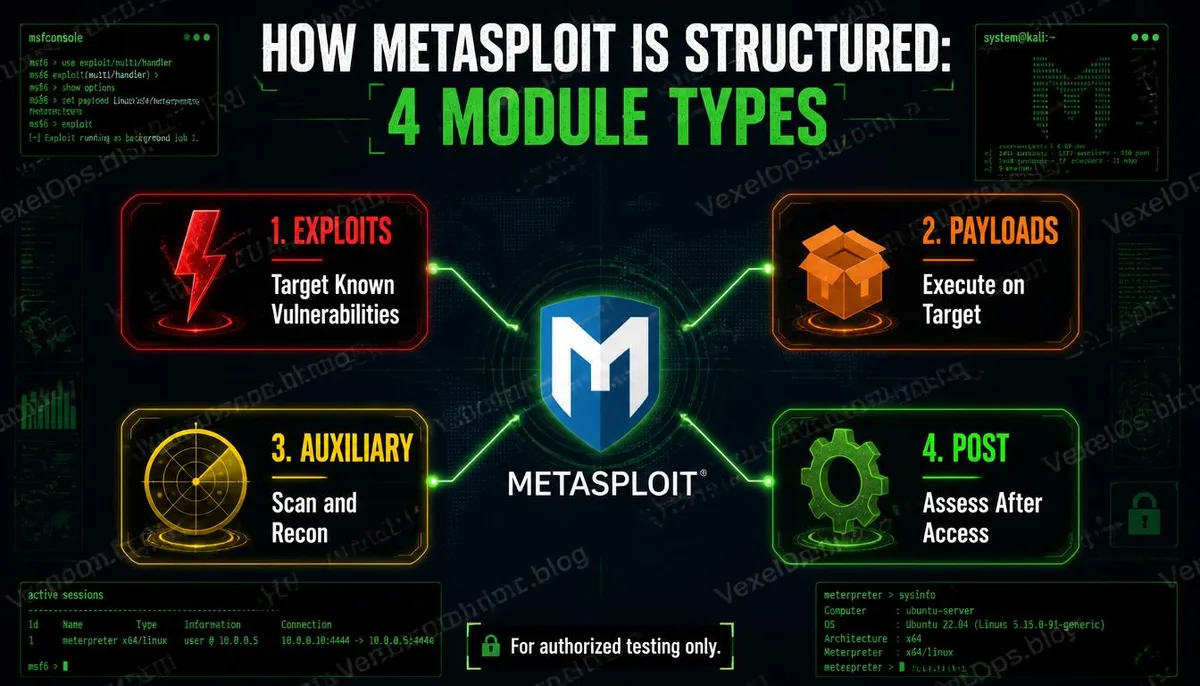
Metasploit is designed in a modular fashion, with different types of functionalities organized into various modules, allowing the framework to be both flexible and easy to expand. The core types of modules include: Exploits Attack codes targeting known vulnerabilities; each exploit module corresponds to a specific vulnerability, such as a buffer overflow in a certain operating system version or an authentication bypass issue in a web application. The vulnerability database of Metasploit is continually updated, covering vulnerabilities from over a decade ago to recently disclosed issues. Payloads Payloads are the code executed on the target system after a successful exploit. The most common type of payload is Meterpreter, which provides an interactive remote control interface, enabling testers to further assess the security state of the system after gaining access. Auxiliary Modules that are not used directly for exploitation but provide support functions during testing, including network scanning, service identification, brute force password testing, etc. Post Modules used after successfully obtaining access to the system, aimed at collecting system
Practical Application Scenarios in Security Work
Metasploit is commonly used in various scenarios of legitimate authorized security work. Enterprise-commissioned penetration testing is one of the most common use cases. When a company wants to evaluate the security status of its infrastructure and hires a security firm for testing, testers utilize Metasploit to systematically conduct vulnerability assessments on the authorized systems, confirming which known vulnerabilities can still be exploited within this environment. Vulnerability reward program research also involves Metasploit. Many tech companies, including Microsoft and Google, have vulnerability reward programs encouraging researchers to test and report vulnerabilities within an authorized scope. Metasploit is a commonly used tool in such research work. In security education and training scenarios, Metasploit is widely used in teaching environments, allowing learners to understand the logic of real attacks in a safe experimental setting, fostering an intuitive grasp of offensive and defensive techniques.
Why Understanding Metasploit Helps Defensive Work
From a defender's perspective, understanding Metasploit holds specific significance. The vulnerability database within Metasploit primarily features known vulnerabilities that are public, meaning if your system has such vulnerabilities, attackers don’t need highly advanced technical skills; they just need publicly available tools to exploit them. This highlights the importance of timely system updates and patch management, turning what may seem like a cumbersome task into a clear necessity. The vulnerabilities exploited by Metasploit are mostly known issues that already have patches, making timely system updates the most direct and effective defense against such attacks. For learners aspiring to enter the information security field, understanding the operational logic of Metasploit is one of the most effective paths to develop offensive and defensive thinking, transforming abstract concepts of vulnerabilities into concrete, actionable understanding.
Common Questions About Metasploit
Is Metasploit Free?
Metasploit offers a free open-source version called Metasploit Framework, which can be obtained through GitHub and is pre-installed in Kali Linux, an operating system designed for penetration testing. The free version includes the core exploitation framework and a large number of modules, sufficient for learning and basic penetration testing tasks. Rapid7 also offers a paid commercial version, Metasploit Pro, which includes graphical interfaces, automated testing processes, report generation, and more, primarily aimed at corporate security teams and professional penetration testing services. Both versions share the same core module database, with the main differences being the user interface and the completeness of automation features.
What Basic Knowledge is Needed to Learn Metasploit?
Before starting to learn Metasploit, several foundational knowledge areas can significantly help in understanding how the tool operates. Basic concepts of network protocols, including TCP/IP, how ports operate, and the fundamentals of HTTP and HTTPS, are prerequisites for understanding Metasploit’s scanning and exploiting modules. Basic operational skills of operating systems, particularly the Linux command line environment, are important since Metasploit primarily runs in Linux environments. A basic understanding of common types of vulnerabilities, such as buffer overflows, SQL injection, and authentication bypass concepts, can help in understanding the purposes and limitations of different modules. While these foundational elements do not need to be mastered, having these concepts as a base makes the process of learning Metasploit more directed and aids in comprehending the logic behind each operation.
Is It Legal to Install Metasploit on One’s Own Computer?
In most regions, simply installing Metasploit is not illegal; it is a legitimate security tool used by thousands of security professionals and learners worldwide. What ultimately determines legality is how it is used. Testing on your own devices, in self-constructed testing environments, or on target systems where you have received explicit written authorization is considered legal use. Testing or attacking with Metasploit on any system you do not own or for which you have not received clear authorization constitutes a criminal offense in the vast majority of regions. This boundary is clear; the nature of the tool does not determine legality; the target of use and whether authorization has been obtained are key factors.
One Key Takeaway: Metasploit allows penetration testers to assess system security using the tools and perspective of attackers. Its existence reminds us that many tools used by attackers are publicly available, and what truly keeps systems secure is the timely patching of known vulnerabilities, rather than assuming that attackers cannot find them.