

When you open any job listing related to cybersecurity, you’ll almost always see a long string of certification acronyms at the bottom: OSCP, CEH, CISSP, CISM. They resemble a secret code, but they serve as important reference indicators for measuring competence in this field. While these certifications sound similar in nature, the exam content and positioning actually differ significantly. Choosing the wrong direction for preparation might result in spending a substantial amount of time and effort, only to find that the certification obtained doesn’t match the career path one wishes to pursue.
OSCP Tests Practical Skills, Not Theoretical Knowledge
OSCP stands for Offensive Security Certified Professional, and is recognized as a highly valuable certification in the field of penetration testing, organized by Offensive Security. The exam format of this certification is entirely different from most others; candidates are not sitting in front of a computer answering multiple-choice questions, but must actually invade a set of simulated environment machines within a limited time of 24 hours and then complete a comprehensive technical report in the time thereafter. This exam design indicates that preparing for OSCP requires a significant investment of time in practical exercises. Simply memorizing theoretical knowledge will not suffice to pass. Due to this characteristic, OSCP is typically regarded in the industry as an indicator of a person's practical penetration testing capabilities, suitable for those looking to pursue technical positions such as penetration testers or red team members.
CEH is an Entry-Level Certification Focused on Breadth
CEH stands for Certified Ethical Hacker, organized by EC-Council, and the exam format is mainly multiple-choice questions, covering a wide range of topics including names and principles of various attack methods and basic uses of common tools. In contrast to OSCP's deep focus on practical skills, CEH helps candidates build a comprehensive cybersecurity concept map, giving them a foundational understanding of various attack techniques and defense concepts within the field. This certification is generally viewed as an entry to mid-level cybersecurity credential, ideal for those just starting to explore the field and wanting to establish an overarching knowledge framework, or as a reference document to prove basic cybersecurity literacy when applying for jobs.
CISSP Focuses on Management and Governance
CISSP stands for Certified Information Systems Security Professional, organized by (ISC)². It is the only certification among these three that clearly leans towards management and governance. The exam covers eight major domains including security governance, risk management, regulatory compliance, and asset security, with a relatively low emphasis on technical implementation. It's worth noting that CISSP typically requires candidates to have a certain number of years of relevant work experience to obtain full certification status. This means it isn’t designed for complete beginners, but rather for those who have accumulated some experience in the cybersecurity field and aim to move into management positions such as cybersecurity managers or Chief Information Security Officers. The official exam outlines and qualification requirements for these three certifications can be directly checked on the Offensive Security website, EC-Council website, and (ISC)² website to obtain the latest version of information.
Summary of the Positioning Differences Among the Three Certifications
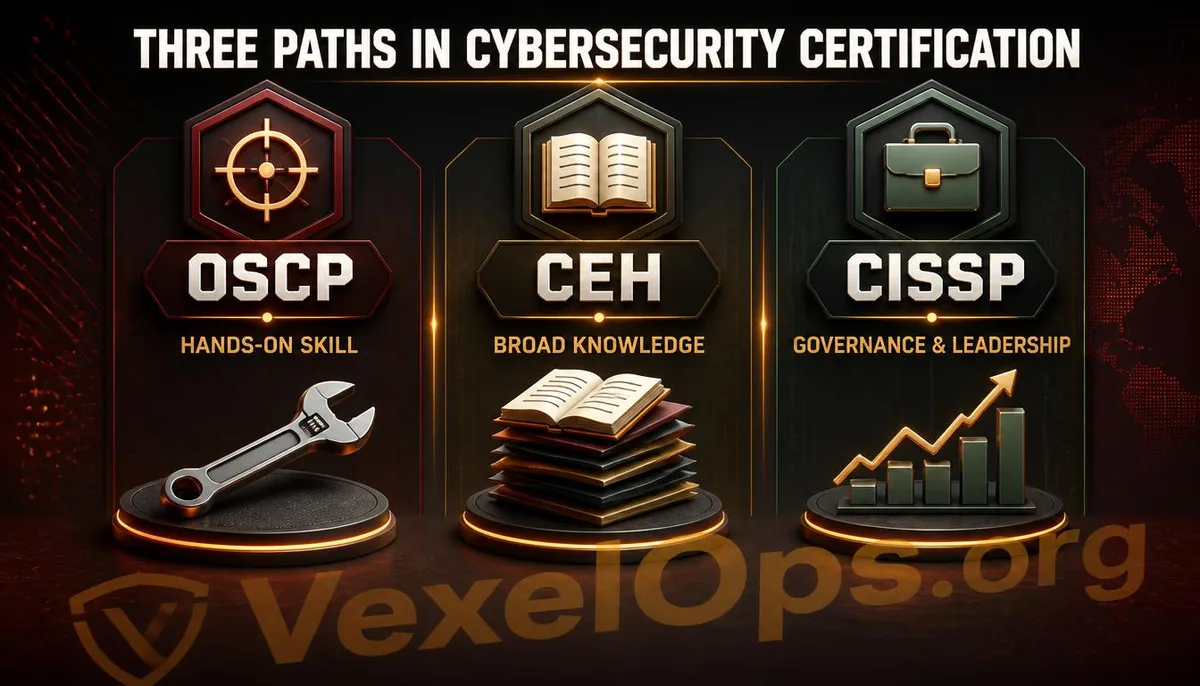
- OSCP: Practical-oriented, assesses real intrusion abilities, suitable for technical penetration testers.
- CEH: Knowledge breadth-oriented, helps establish overall cybersecurity concepts, serves as an entry-level reference.
- CISSP: Management and governance-oriented, requires work experience, suitable for mid to senior management positions.
If you're unsure of which direction to prepare for, you can also refer to low-cost or free practical exercises like CTF competitions and Bug Bounty as mentioned earlier. Accumulating experience through practical problem-solving often clarifies where your true interests lie more effectively than simply spending money on certifications.
Common Questions Users Ask About Choosing Cybersecurity Certifications
Should I Jump Straight into OSCP Without Any Background in Cybersecurity?
It is not recommended to challenge OSCP without any foundational knowledge because the exam format requires candidates to independently complete real intrusion tasks within a limited time. If you are not familiar with basic concepts of networking or the operational logic of commonly used penetration testing tools, the preparation process will be considerably challenging and you may struggle to identify the sources of your difficulties. A more prudent path is to first gain familiarity with basic concepts and tool operations through CTF practice or broader knowledge-oriented certifications like CEH, before advancing to practical certifications like OSCP.
What is the Typical Cost Range for These Certifications?
Certification costs can vary based on pricing policies set by the organizing institutions and may fluctuate due to regional or exchange rate differences. Generally, the registration fees for these certifications fall within the range of several hundred to over a thousand U.S. dollars. OSCP typically costs slightly more than purely multiple-choice format exams, as it includes expenses for renting the practical exam environment. It's advisable to check the official websites of each organizing institution for the most current announced costs before making a decision to register, as these figures can change over time and should be validated against official announcements rather than relying on outdated data found online.
Does Obtaining a Certification Guarantee Job Placement?
Certifications are valuable documents in the job application process, but they are generally not the sole determining factor. Most employers evaluate candidates for cybersecurity-related positions based not only on certifications but also on practical experience, demonstrated practical skills during interviews, and the depth of understanding of specific fields. Certifications are better positioned as tools to help resumes pass preliminary screenings and to demonstrate a certain level of foundational knowledge, while actual career development still requires continuous accumulation of practical experience and technical skills.
One Key Takeaway: The OSCP focuses on practical skill verification, CEH is suitable for establishing a broad foundational knowledge framework, while CISSP leans towards management governance and requires work experience. Clarifying whether you want to pursue a technical implementation or a management path before choosing a certification is more efficient than blindly following trends.