
Many People Think the Problem is Passwords; The Real Issue is with the Recovery Entry Points
When a Google account cannot be logged into, most people's first reaction is that the password is wrong, prompting them to repeatedly attempt to reset it. However, in many instances of account anomalies, the real sticking point is not the password, but rather that the recovery entry points have been changed or compromised. The security structure of a Google account depends not only on a password but also on multiple recovery criteria, such as backup emails, phone numbers, login devices, and two-factor authentication methods. If any one of these is altered or falls out of control, it can lead to a situation where, even if the correct information is entered, the recovery process cannot be completed.
Account Recovery is Actually a Pathway, Not a Button
Many people have a misconception about account recovery, thinking that simply clicking 'Forgot Password' will directly lead to a successful login. In reality, Google's recovery process is a judgment pathway. The system assesses whether you are the legitimate owner of the account based on the following criteria: - Recently used login devices - Common login locations - Linked phone numbers - Backup email addresses - Two-factor authentication methods - Historical passwords or usage habits If these criteria do not match, the system will lower its trust level, meaning that even if you enter the correct password, you may not be able to pass verification.
The Most Easily Overlooked Issue: Recovery Email and Phone Number Changes
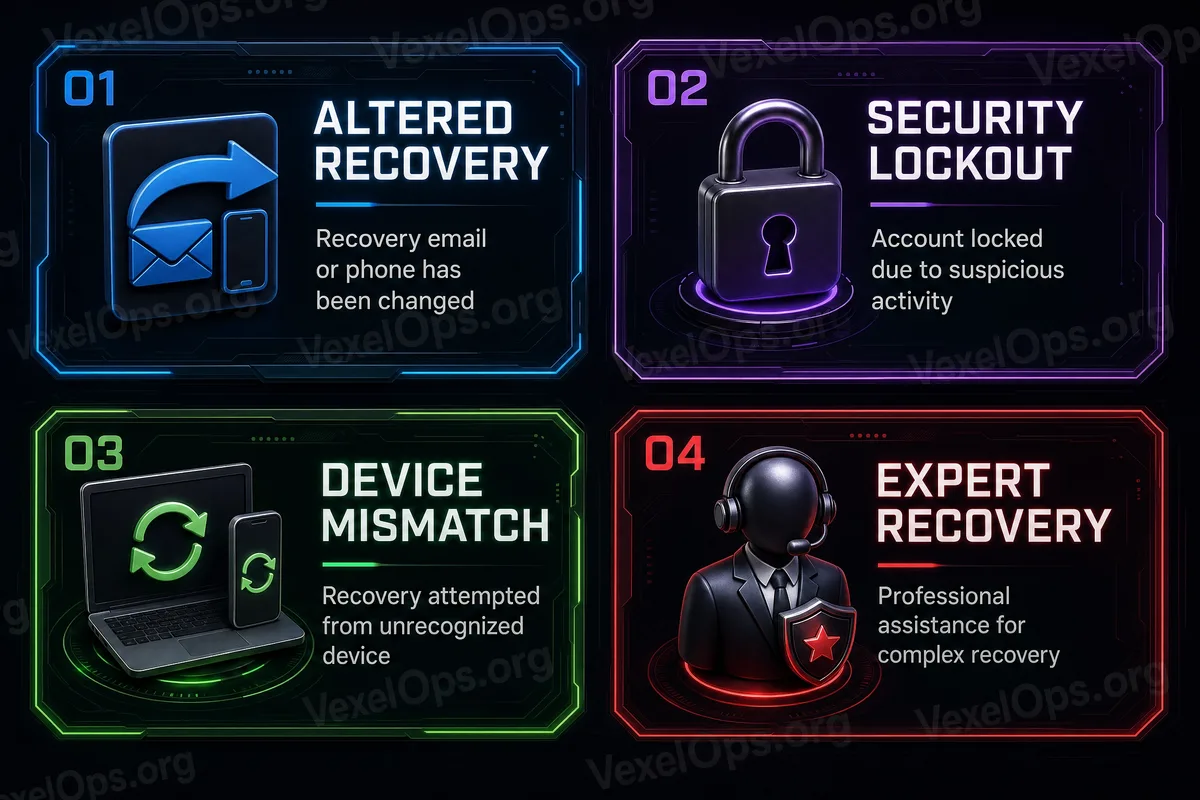
In cases where accounts are compromised or accessed anomalously, attackers typically do not stop at the password level but prefer to first modify recovery information. For example: - Removing the original recovery email - Changing the phone number - Adding their own backup email - Modifying the two-factor authentication method - Setting new trusted devices These changes can lead the original account holder to lose key verification conditions during recovery. The result is that even if you remember the password, you cannot prove that you are the account owner.
Why Recovery Processes Are Becoming More Difficult
Google's design aims to prevent easy retrieval of accounts once they have been hacked, which means that recovery conditions become stricter over time. When the system identifies any of the following situations, the success rate of recovery declines: - Attempts to log in from new devices - Login location differing from the past - Inability to provide historical passwords - Unable to use the original phone number - Inaccessible backup email This is why some users find themselves in a cycle of repeated failures.
It's Not That the Account is Broken, But Rather the Trust Chain is Broken
The core of account recovery is not about entering the correct information but whether the system trusts you. When recovery entry points are altered, Google considers the new recovery methods as trusted sources rather than the original user. At this point, the problem becomes less of a technical issue and more about the identity verification chain being broken.
Common Mistakes That Complicate Recovery Further
Many people make counterproductive moves when they cannot log in, such as: - Constantly trying to log in with different devices - Rapidly resetting their password multiple times - Using VPNs to switch locations - Attempting different backup emails These actions may lead the system to classify them as anomalous behavior, further diminishing the recovery success rate.
If Your Account Has Entered a Difficult Recovery State
When you realize that: - The password is correct but still cannot log in - The backup email is invalid or nonexistent - The phone number cannot receive verification codes - The system continually rejects recovery requests This usually indicates that the recovery entry points are no longer intact. In such cases, the problem is typically not a single setting but rather a need to reassess the entire account status, including login records, the history of recovery information changes, and trusted device sources. In these situations, some users choose to organize the information before seeking professional account security analysis or recovery assistance.
The Real Key to Account Security is Proactively Protecting Recovery Entry Points
More important than remembering your password is ensuring the following information is always under your control: - Recovery email - Linked phone number - Two-factor authentication method - Trusted devices Because once these are changed, the account issue is no longer just about logging in but rather a complete control issue.