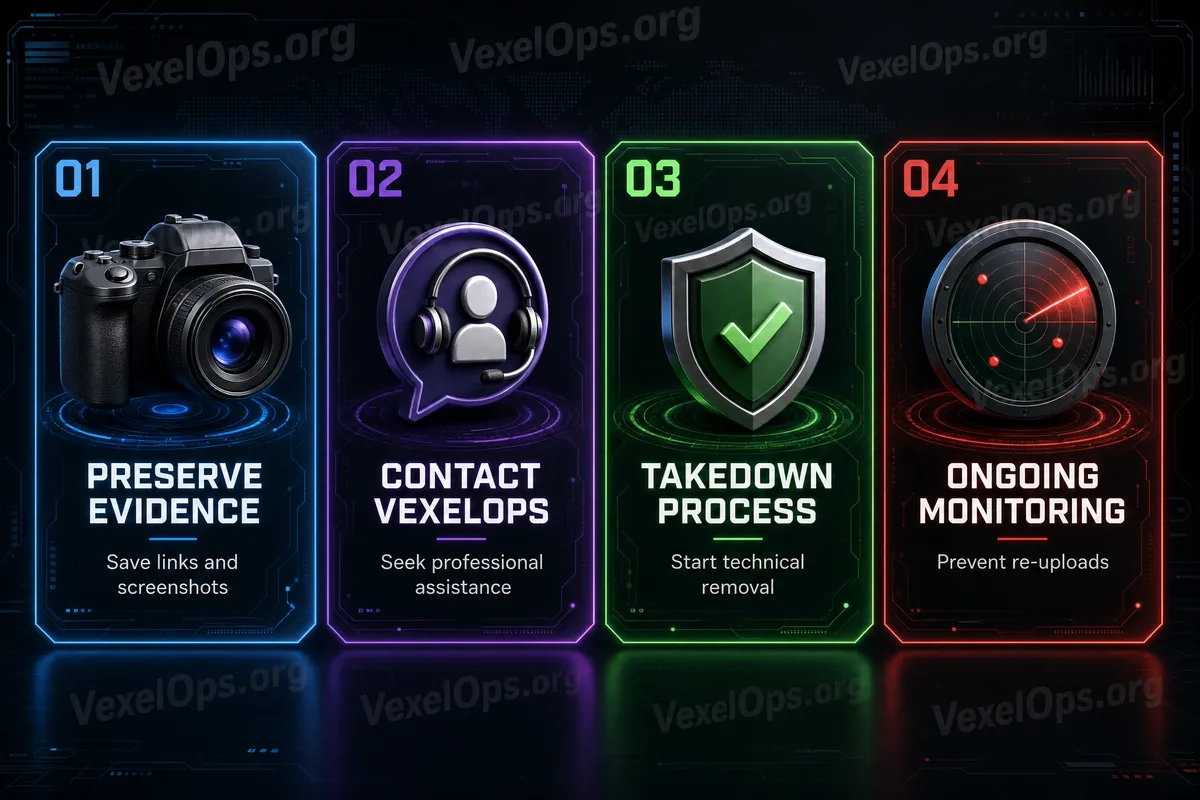

Organize the Issues First, Then Start the Takedown Process

When private videos, intimate images, or inappropriate content leak and are uploaded to adult websites, it's a very sensitive and high-pressure situation. Many people initially feel scared and anxious, even wanting to contact the website, message the uploader, or find quick methods to remove the content immediately. However, in such events, the more urgent it feels, the more orderly the process needs to be. Because adult websites, search engines, social platforms, Telegram groups, X posts, Facebook groups, Discord servers, or other reposting pages may have different removal methods. Without first organizing the information, it's easy to miss key points during communication and may also lead to submitting incomplete complaints repeatedly. VexelOps' assistance focuses on helping users organize event information into a clear, traceable process, including which platforms the content appears on, whether the links are valid, publication times, account information, whether threats or extortion are involved, and which entry points should be addressed first.

After a Private Content Leak, Protect Yourself and the Evidence First

When dealing with a leak of private videos, the first step is not to share the videos widely for confirmation, nor to repeatedly download the content for safekeeping. A safer approach is to organize the necessary information to prevent further dissemination of the content. It is advisable to first record the following information: 1. The names and URLs of the websites where the content appears 2. The date and time the content was discovered 3. The account, nickname, or page information of the uploader 4. Whether the title, description, or keywords include your name, social media account, or phone number 5. Whether it appears in Google, Bing, or other search results 6. Whether the content has also been reposted to platforms like Telegram, X, Facebook, Reddit, Discord, etc. 7. Whether anyone is using the content to threaten, extort, or demand payment This information can help later determine the extent of the incident and can also make complaint content more complete. When organizing the data, the focus should be on preserving website locations, publication information, and timelines, rather than repeatedly sending the private videos to more people.

What Content Can VexelOps Assist in Organizing?

VexelOps can assist users in organizing chaotic event information into clearer handling data. Many users may only have a few screenshots, URLs, some chat records, and scattered messages when dealing with a leak of private images and are unsure which platform to handle first or what information is suitable to provide. By contacting VexelOps.org, VexelOps.net, or Telegram @vexelops, users can organize based on the situation: - Links to adult websites or platform pages - Content titles, publication times, and account information - Screenshots of search results and keywords - Threats, extortion, or messages disseminated by others - Relevant chat records and timelines - Records of complaints submitted to platforms - Lists of pages needing follow-up The benefit of this approach is that it makes the entire event manageable. Once the data is organized, whether submitting removal complaints to the platform, requesting removal of search results, or communicating with legal or other support channels, it will be clearer.

Platform Complaints Need to Be Clear, Complete, and Verifiable

When adult websites or social platforms handle private image complaints, they usually need to know the content's location, reasons for the complaint, privacy issues involved, and the relationship between the complainant and the content. The forms for different platforms may not be the same, but the logic typically revolves around several key points: whether the content was published without consent, whether it contains personal identifiable information, whether it involves harassment or extortion, and whether it violates platform policies. If the complaint data is too fragmented, the platform may find it difficult to assess the content and may request supplementary information. VexelOps can assist users in organizing their complaint data more coherently, such as separating website links, screenshots, uploader information, event times, and complaint explanations, to avoid submitting too much chaotic content at once. If the content has already appeared in Google search results, search keywords, search results pages, original URLs, and content titles can also be separately organized. Removing search results and takedown requests from the original site are usually two different

Flowchart for handling private image leaks, demonstrating organization of website links, platform complaints, removal of search results, event timelines, and privacy protection

If Content Is Reposted Multiple Times, Order of Processing Is Important

After a leak of private videos, it sometimes appears on more than one website. It may start on an adult website, then get indexed by search engines, and subsequently reposted on forums, Telegram groups, X accounts, or other pages. In such cases, the order of processing becomes important. Generally, you can start by organizing the original content page, then move on to the search results and reposted pages. If you can identify the earliest published location, subsequent tracking will be more directed. If the source cannot be confirmed, you can also begin with pages that are still accessible, still appearing in search results, or those most likely to cause exposure. VexelOps can assist users in creating a list of pages, marking the status of each URL clearly, such as discovered, screenshot taken, complaint submitted, awaiting reply, needing supplementary information, removed, or still needing tracking. This approach can reduce redundancy in handling and make subsequent communication more efficient.

Do Not Hand Sensitive Content to Untrustworthy Individuals

When dealing with leaks of private images, many people become anxious and trust promises made by strangers, such as "guaranteed removal from the internet," "immediate permanent removal," "pay first then we’ll deal with it," or "provide the original video to proceed." These types of statements should be approached with caution. A safer method is to only provide the event information necessary for processing, such as the URL, page screenshots, publishing account, timelines, and platform locations. Do not share passwords, verification codes, cloud account details, complete private footage, or any unnecessary personal data with strangers. VexelOps prioritizes data organization, complaint preparation, risk assessment, and streamlined processing, and will not ask users to hand over account passwords, verification codes, private keys, or unrelated sensitive permissions. This allows users to organize events more securely while protecting their privacy.

Make the Handling of Private Video Incidents More Directed

When private videos are uploaded to adult websites, the greatest fear is being anxious and losing direction in handling the situation. Effective processing typically involves not asking around aimlessly or making blind payments, but rather establishing a clear data table: where the content is, who published it, when it was discovered, whether it’s indexed in searches, whether there are threat messages, which platforms have already complained, and which pages still need monitoring. VexelOps can assist users in organizing these fragmented pieces of information into a clearer handling process, making takedown requests, search result removals, platform reporting, and subsequent risk assessments more orderly. If you encounter private image leaks, re-uploading of adult websites, search result exposure, or related threat messages, you can visit VexelOps.org, VexelOps.net, or Telegram @vexelops for assistance and begin with data organization to bring the incident back under control.