
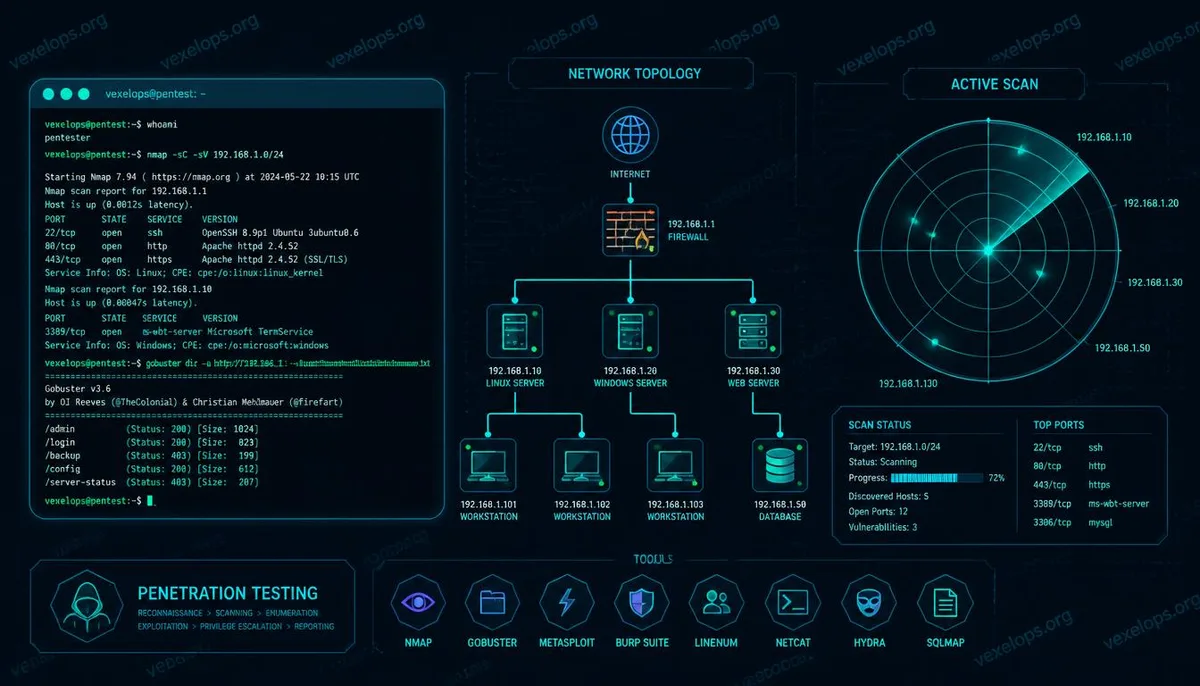
Penetration testing, simply put, involves authorized security personnel simulating real attack methods to proactively identify vulnerabilities in systems, websites, or networks, thereby assisting organizations in addressing these issues before actual attacks occur. It is crucial that such testing is conducted only with clear authorization from the owners of the target systems; otherwise, the same actions could constitute unauthorized intrusion, violating relevant laws and regulations. In this field, testers usually do not rely solely on manual operations but combine a series of established tools to enhance efficiency and accuracy. Each tool typically corresponds to a specific phase in the attack chain, ranging from initial information gathering and vulnerability scanning to subsequent vulnerability validation and privilege escalation. Below are ten widely used tools in the industry, along with descriptions of their positioning, modes of operation, and practical application contexts.
1. Nmap: The Basic Tool for Network Scanning
Nmap is one of the foundational and most commonly mentioned tools in penetration testing, primarily used to scan target networks for open ports, identify running services, and detect operating system versions. Almost every testing process begins with a comprehensive network scan. Its operational principle involves sending various specially crafted network packets to the target host and judging whether the port is open and which services are running based on the responses. Furthermore, it can even predict the type and version of the operating system behind it. For businesses, regularly using similar scanning logic to inventory exposed services is a fundamental task for reducing attack surfaces, as many intrusion incidents stem from an outdated service that remains forgotten yet open to the outside.
2. Metasploit: The Automated Attack Framework
Metasploit is a testing framework that integrates numerous known exploit modules, allowing testers to quickly verify whether a known vulnerability exists in the target system. Due to its modular design, it is also commonly used in cybersecurity education courses to demonstrate the basic principles of exploiting vulnerabilities. The value of this framework lies in its ability to encapsulate processes that would traditionally require extensive manual coding to perform vulnerability validation into reusable modules, significantly reducing the time needed for testing. For enterprise security teams, understanding the common vulnerabilities included in Metasploit indirectly equips them to know the attack paths hackers are likely to prioritize, enabling targeted enhancement of patching and monitoring.
3. Burp Suite: The First Choice for Web Application Testing
For security testing of websites and web applications, Burp Suite is nearly the industry standard tool. It can intercept and analyze all transmission content between browsers and servers, assisting testers in identifying common web vulnerabilities like SQL Injection and Cross-Site Scripting. In addition to basic traffic interception functions, Burp Suite offers advanced features such as automated scanning, form field fuzz testing, and resending modified requests, allowing testers to systematically assess how a website responds to various abnormal inputs. Many enterprises commission their security teams to perform a comprehensive test in a similar manner before launching new features.
4. Wireshark: The Core Tool for Packet Analysis
Wireshark is a network packet analysis tool capable of capturing and parsing every packet content in network traffic in real time. It is indispensable for analyzing suspicious traffic, diagnosing network issues, or clarifying the specific transmission processes during an attack. Its interface breaks down each captured packet according to protocol layers, allowing testers to clearly see the source address, destination address, transmitted content, and even reconstruct the full conversation. In post-attack forensic investigations, Wireshark's packet records often serve as one of the key sources of evidence for reconstructing the sequence of events.
5. John the Ripper: Password Strength Testing Tool
This tool is primarily used to test the strength of hashed passwords, allowing testers to evaluate how long it would take for a specific password to be cracked under brute-force or dictionary attacks, thereby prompting organizations to strengthen their password policies. It supports testing for various hashing algorithms and can attempt cracking based on common password dictionaries and rule combinations. The results obtained from such testing allow organizations to quantitatively assess the strength of existing password policies, such as how long passwords should be or whether complexity requirements should be enforced to extend the time required for cracking to a level that is not a significant threat.
6. Hydra: Login Authentication Testing Tool
Hydra is commonly used to test various login services (such as SSH, FTP, and web login forms) for their defenses against automated login attempts, helping to assess whether the system has sufficient locking mechanisms and rate limits in place. During testing, Hydra rapidly tries vast combinations of usernames and passwords; if the target system has not set limits on login failures or rate limits, there is theoretically a risk of it being cracked brute-force. This is why many platforms will require graphical verification or temporarily lock accounts after multiple failed login attempts, aiming to thwart such automated attempts.
7. Nikto: Website Server Vulnerability Scanning
Nikto focuses on scanning common issues in website server configurations, such as outdated software versions, insecure default files, or known vulnerable settings, making it suitable as the first screening tool for website security checks. It sends numerous known test requests to the target server and compares the server's responses, quickly listing potential risk items that may exist. Although scanning results may sometimes include false positives, Nikto can help administrators gain a quick understanding of what known configuration oversights a website may have, acting as an initial health check tool.
8. Aircrack-ng: Wireless Network Security Testing
This tool is primarily used to assess the security of Wi-Fi networks, allowing testers to check the strength of wireless encryption, helping organizations determine whether their existing Wi-Fi protections are sufficiently secure. It encompasses functions for packet capturing, key cracking, and wireless traffic analysis and is often used to verify whether outdated encryption protocols (such as the obsolete WEP) still exist within an organization's internal network. For homes and small offices still using outdated router devices or that have never updated their wireless passwords, the risks exposed by such testing are especially noteworthy.
9. OWASP ZAP: Open Source Web Security Scanner
As an open-source alternative to Burp Suite, OWASP ZAP also focuses on web application security testing, covering functions for both automated scanning and manual testing, making it a relatively easy choice for budget-conscious teams or newcomers learning cybersecurity. Being completely free and continuously maintained by the community, OWASP ZAP is frequently integrated into enterprises' automated development processes, executing a basic security scan automatically before every code deployment to intercept obvious vulnerabilities early, rather than discovering problems only after going live.
10. Kali Linux: Integrated Testing Operating System
Strictly speaking, Kali Linux is not a single tool but a complete operating system that pre-integrates most of the above tools, specifically designed for penetration testing and cybersecurity research. Many cybersecurity professionals utilize Kali Linux as their operational platform. This system is maintained by the Offensive Security team and comes pre-installed with hundreds of cybersecurity tools, categorized by function, making it easy for users to quickly find the corresponding tools according to the testing phase. For learners newly entering the cybersecurity field, Kali Linux is often used as a practice environment, paired with legitimate online testing platforms for simulated exercises, without involving any risks related to real systems.
The Existence of These Tools Reflects the Ongoing Tug-of-War Between Offense and Defense
Understanding the purposes of these tools does not encourage readers to use them for testing unauthorized targets but helps the general user understand why organizations need to allocate resources for regular cybersecurity testing. When you know that hackers might use similar tools to seek system weaknesses, it also helps you comprehend why timely software updates, setting complex passwords, and limiting unnecessary service exposure are critical measures for reducing the risk of being compromised. For the everyday user, what truly matters is not learning how to operate these tools but understanding the core principles behind the attack and defense logic, thereby fostering more cautious cybersecurity habits when using internet services.