
When CPU Isn't Fast Enough, Let GPU Handle It
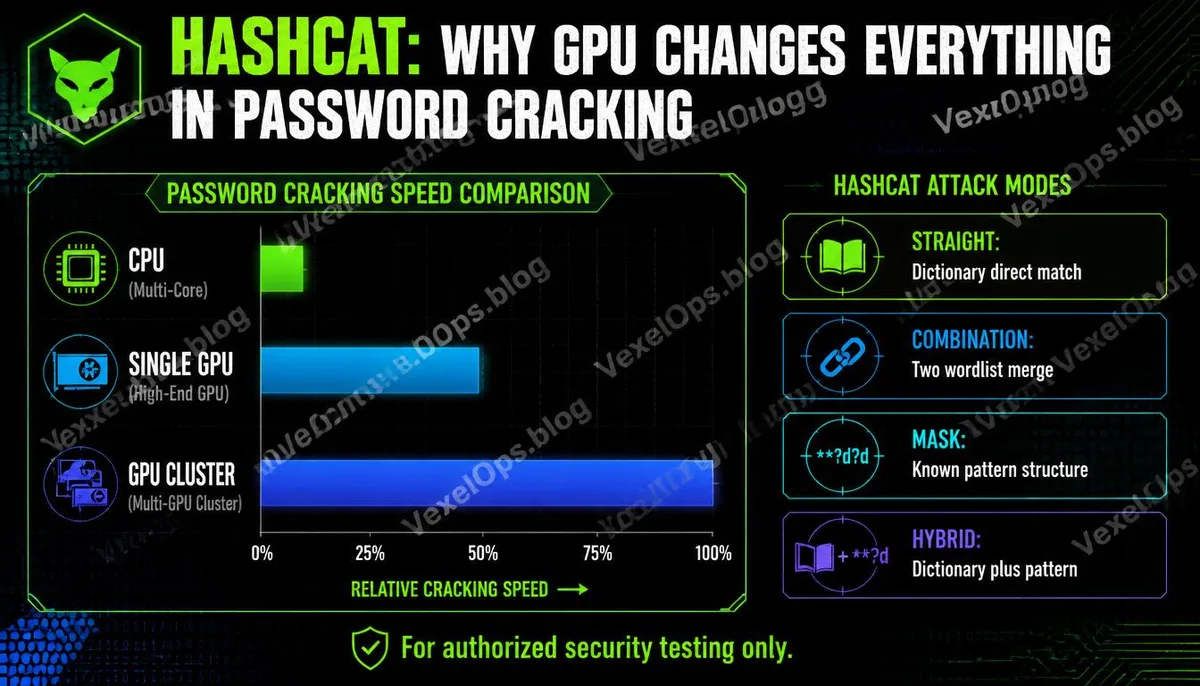
John the Ripper is a classic among password cracking tools, but it mainly relies on CPU calculations. In modern computing environments, this design has limited speed potential. Hashcat employs a completely different strategy by offloading password cracking computations to the GPU. Originally designed for graphic rendering, GPUs are built to handle numerous parallel computation tasks simultaneously. A modern consumer-grade graphics card can execute thousands of processing cores at once, and password hashing calculations fit perfectly into this parallelizable task type. This allows Hashcat to achieve speeds several orders of magnitude faster on the same hardware compared to traditional CPU tools. A mid-range GPU from 2023 can attempt over ten billion MD5 hash combinations per second. At this speed, an eight-digit numeric password can be brute-forced in just a few milliseconds.
Hashcat Supported Attack Modes
Hashcat offers multiple attack modes targeting different types of password weaknesses: Straight Attack Directly attempts passwords from a dictionary or password list, the fastest method and most effective against common passwords. Hashcat's official and cybersecurity community maintain a substantial number of password dictionaries, notably the RockYou dictionary, which contains over fourteen million actual user passwords collected from various data breaches. Combination Attack Combines words from two dictionary files to attempt passwords formed by two common phrases, such as combining sunflower and 2023 into sunflower2023. Mask Attack Targets known password structures; for example, if it is known that the target password is a combination of four lowercase letters followed by four digits, this mask can be defined to only try combinations that meet this structure, significantly narrowing the search space. Hybrid Attack A combination of dictionary and mask methods; adding specific prefixes or suffixes to each word in a dictionary to cope with common password habits where people add numbers or symbols after basic words. Further reading: What is John the Ripper?
Practical Applications in Cybersecurity Work
In authorized penetration testing environments, Hashcat frequently appears in the following scenarios: When testers acquire a system's password hash database and need to assess what percentage of these passwords are crackable within a reasonable timeframe, Hashcat provides the necessary tools for this evaluation. The results of this test are used to support recommendations for companies to adjust password policies, such as enforcing minimum password lengths, prohibiting common passwords, or shortening password validity periods. In corporate cybersecurity red team exercises, Hashcat is also a standard tool. The red team's goal is to simulate the behavior of real attackers, and attempting to crack passwords after obtaining hashes during a simulated intrusion is an essential part of assessing the overall security posture of the organization.
What This Tool Teaches Us About Password Reality
The existence of Hashcat and its computational speed have a very direct implication for everyday users. Many people, when setting passwords, choose a meaningful phrase combined with a few digits and a symbol, such as Summer@2023, believing that is sufficiently complex. However, "Summer" exists in all major dictionaries, "2023" is a common year suffix, and the '@' symbol is one of the most frequently substituted symbols. The entire password could be found in just a few minutes during a Hashcat session equipped with a rule engine. Passwords that are truly resistant to tools like Hashcat typically exceed sixteen characters, use genuinely random character combinations, and contain no predictable structures. Such passwords are nearly impossible for humans to remember, which is where password managers truly shine, allowing each account to use a strong password generated solely by machines without human memory aid.
Common Questions Cybersecurity Learners Ask About Hashcat and GPU Password Cracking
How Should I Choose Between Hashcat and John the Ripper? What Are the Fundamental Differences?
The core difference between the two lies in their computational architecture and usage scenarios. John the Ripper primarily utilizes CPU resources, has a long history, and supports a wide range of platforms and formats. In environments lacking dedicated GPUs or when a basic cracking task needs to start quickly, it remains a very practical tool. Hashcat’s core design centers around GPU acceleration, making its speed advantage very pronounced in environments with dedicated graphics cards. It supports over three hundred hashing formats and offers more flexible combinations of attack modes. In actual cybersecurity work environments, the two tools are not mutually exclusive. Security professionals often decide which tool to use based on task nature and available hardware, and they may use them in tandem. For beginners, John the Ripper has a slightly lower entry threshold, while Hashcat can provide stronger practical capabilities once the basic concepts are mastered.
Can Cloud Computing Make Hashcat Faster?
Indeed, and this method is currently being utilized in cybersecurity research and some penetration testing environments. AWS, Google Cloud, and Azure all offer high-end GPU-equipped cloud computing instances available for on-demand rental. Compared to personal hardware, cloud GPU clusters can elevate Hashcat’s computational speed to another order of magnitude, reducing cracking tasks that previously took days to just a few hours or even less. This reality illustrates from another angle why password length is so important; as available computational resources continue to increase, the threshold for what was once considered adequately secure password lengths continues to rise.
What Kind of Hardware Environment Does Hashcat Require?
Hashcat supports mainstream GPUs from NVIDIA and AMD, as well as some Intel integrated graphics. Performance is best in environments with dedicated graphics cards, supporting both NVIDIA's CUDA platform and AMD's ROCm. If there is no dedicated graphics card, Hashcat can run in CPU mode, but speed is dramatically reduced, approaching the CPU performance levels of John the Ripper. Hashcat runs on Windows, Linux, and macOS, with precompiled binaries available from the official Hashcat website hashcat.net, eliminating the need for self-compilation. In Kali Linux environments, Hashcat is also one of the pre-installed tools available for immediate use.
One Key Takeaway: Hashcat leverages the parallel computing power of GPUs to achieve a speed in password cracking that is difficult for the average person to intuitively grasp. Its most important insight is not how powerful the tool is, but that in the face of this computational capability, our intuitive judgment about password strength is often much more optimistic than the actual situation.