

Victims of cryptocurrency fraud often resign themselves to hopelessness immediately after a loss occurs, believing the irreversible nature of cryptocurrency means that funds, once transferred, are forever gone. This understanding is only half correct. Although transactions themselves are indeed irreversible, no one can unilaterally revoke a confirmed on-chain transaction. However, the flow of funds is permanently traceable, and under certain conditions, taking action through the correct channels can lead to the freezing of related assets or even an opportunity for funds to be returned, which has occurred in real cases. The key is not luck, but how quickly you act after a loss and whether those actions are supported by complete information.
The Public Nature of Blockchain: Victims' Most Important Tool
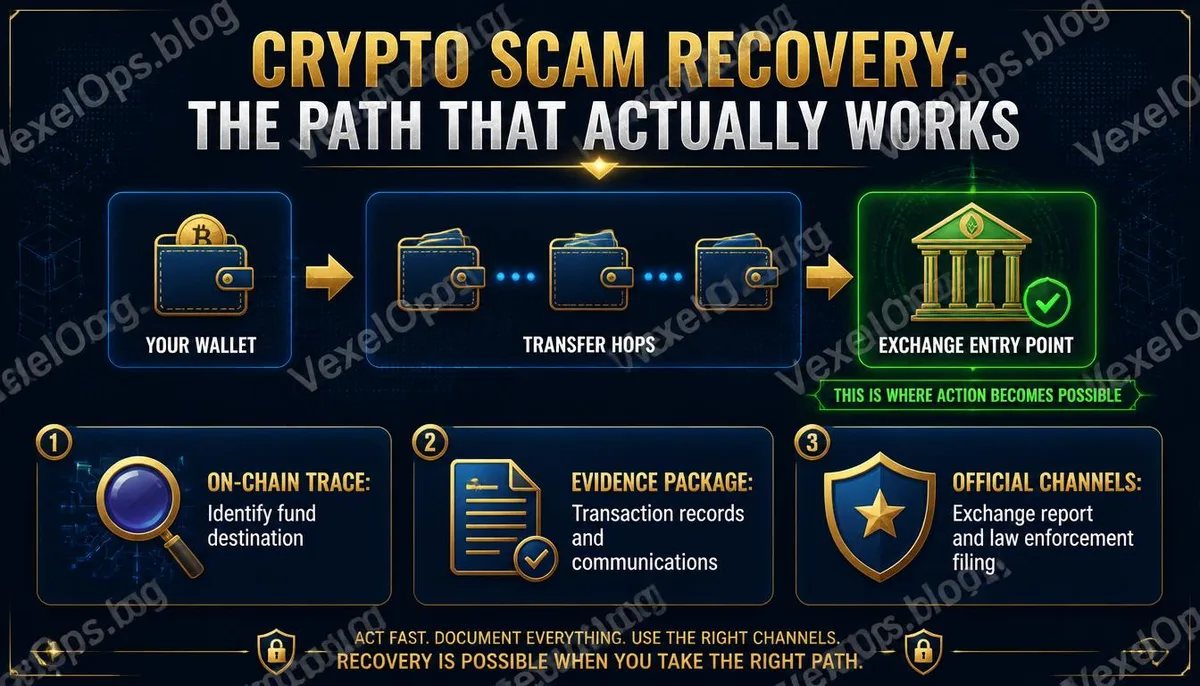
Every cryptocurrency transaction has a unique transaction hash that can be queried on the corresponding blockchain explorer for complete transaction details, including the wallet addresses of the sender and receiver, transaction amounts, timestamps, and subsequent flow of funds. For example, by entering your transaction hash on Etherscan or TRONSCAN, you can clearly see which wallet the USDT funds were transferred to and where they went afterward. If the funds ultimately flow into a deposit address of a centralized exchange, that node becomes the most important entry point for subsequent actions. Centralized exchanges have the ability to track incoming funds and have regulatory obligations. When they receive a properly documented fraud complaint, some exchanges will cooperate by freezing related accounts and waiting for investigations by law enforcement agencies. This mechanism is real and has been proven effective under certain conditions.
The Actual Process of On-Chain Tracking
The first step victims can take is to track the flow of funds on a blockchain explorer and establish a basic record of the transaction path. However, fraud groups typically do not let funds sit idle; they will use multiple intermediary wallets for decentralization and transfer, complicating tracking efforts. This process requires an understanding of the different fund flow logics on various chains, as well as common fund obfuscation techniques such as cross-chain bridges and mixers, in order to create a truly persuasive tracking report. Professional on-chain analysis tools like Chainalysis, Elliptic, and TRM Labs are commonly used by law enforcement agencies and compliant exchanges when dealing with such cases as they can trace the complete path of funds across multiple wallets and chains, identifying known fraud addresses or money laundering patterns. VexelOps can assist victims in this tracking process by compiling your transaction data into a structured on-chain analysis report, confirming which node the funds entered which exchange or known address cluster, ensuring that every subsequent complaint and reporting step is backed by concrete documentation.
Organizing Evidence: The Basis for All Subsequent Actions
Before taking any external actions, it is necessary to organize all relevant information thoroughly. This preparatory work directly influences the success probability of each subsequent step. The information to be organized includes: - All communication records with the fraudster, including message screenshots, call logs, and emails - All transfer proofs, including transaction hashes, transfer amounts, timestamps - Account names, wallet addresses, and platform information used by the other party - A complete timeline of events, from the first contact to the discovery of the fraud The completeness of this documentation directly impacts how much resources law enforcement agencies are willing to devote to your case, as well as the speed and rigor of the exchange's processing after receiving a complaint.
Specific Steps for Complaining to Exchanges
If on-chain tracking confirms that the funds flowed to a specific centralized exchange, a complaint can be submitted directly to the compliance or risk management department of that exchange. Major exchanges typically have dedicated procedures for handling fraud complaints, including Binance, OKX, and Coinbase, all of which provide this channel. The core information needed when filing a complaint is your transaction hash and on-chain proof of the funds flowing into the other party's account, providing the exchange's compliance team with concrete evidence to verify the source and nature of the funds. After filing a complaint, the possible actions the exchange may take include freezing the withdrawal functions of relevant accounts, cooperating with law enforcement investigations, or assisting in the return of funds in clear cases. This process is not immediate, but for cases where funds remain in exchange accounts, the timeliness of this window is crucial; the sooner the complaint is submitted, the better.
The Significance of Reporting to Law Enforcement
Reporting establishes a formal record of the crime, one of the most important foundations for all subsequent actions. The Criminal Investigation Bureau in Taiwan's anti-fraud consultation hotline 165 and the criminal units of various city police departments handle cryptocurrency fraud cases. When reporting, it's essential to bring complete evidence documents, including an on-chain tracking report, communication records, and transaction proofs, to allow law enforcement to more quickly assess the case and decide whether to initiate a formal investigation. With adequate evidence, law enforcement can issue formal requests for assistance to relevant exchanges, and this request has far greater legal validity than an individual's complaint, making it the strongest pathway for prompting exchanges to take action. For cases involving cross-border fund flows, certain international cooperation frameworks also facilitate information sharing between multinational law enforcement agencies, although this pathway tends to have a longer time cycle, tracking it is worthwhile for cases of larger fund scale.
Common Questions Victims Ask About Tracking After Cryptocurrency Fraud
How long after funds are transferred is there still an opportunity to track and freeze them?
Time is one of the most critical variables. The faster funds are tracked after being transferred, the higher the likelihood of them staying in a freezeable position. Fraud groups typically perform decentralization transfers within a period after receiving the funds; each transfer node increases the difficulty of tracking. However, even if the funds have passed through multiple intermediary wallets, on-chain records remain intact. There are many precedents in which law enforcement has successfully intervened to freeze assets even weeks or months after a loss occurs, provided there is sufficient documentation. The most important thing is not to give up taking action simply due to the passage of time, but also not to delay, as every day that passes increases the chance of further obfuscation of the funds.
If the fraudsters used a decentralized wallet instead of an exchange, is there still a way to track it?
Decentralized wallets significantly increase the difficulty of freezing funds since there is no central authority that can take action against that wallet. However, on-chain tracking is still meaningful because fraud groups ultimately need to convert the cryptocurrency into fiat currency, which nearly always requires them to go through regulated centralized exchanges. Tracking the complete path of funds from a decentralized wallet to their final entry into an exchange provides specific targets for complaints and law enforcement intervention. Additionally, some known fraud addresses have already been flagged by major exchanges and on-chain analysis agencies; subsequent transfers into these addresses will trigger alerts within compliance systems, which is why complete on-chain reports are especially important in such cases.
Is it worth spending time on these procedures for small amounts lost?
Every case should be judged based on its actual situation, but several considerations are worth factoring into this decision. First, the essential resources required for organizing evidence and filing a report are time, not money; preserving information does not incur extra costs. Second, the perspective of law enforcement is not solely the amount of a single case but rather the overall activity patterns of the fraud group. Your report may become a piece of the puzzle that helps law enforcement grasp the operating patterns of a certain fraud group, indirectly aiding the cases of other victims. Third, for confirmed cases of funds entering a complainable exchange, even for small amounts, the cost of complaint itself is low and is a worthwhile step to try.
One Key Takeaway: After a cryptocurrency scam, it's not that nothing can be done. The transparency of the blockchain makes it possible to trace funds, and organizing complete evidence, on-chain analysis reports, and filing complaints through the correct channels to exchanges and law enforcement is the basis for keeping all subsequent possibilities open.