

Your Data May Already Be Circulating Somewhere—You Just Don't Know It
Every time a major data leak occurs, the number of affected accounts often counts in the millions. The 2021 Facebook leak involved over 500 million account records, and the 2019 Collection leak contained over 700 million email and password combinations. Once this data leaks, it circulates across various forums and sales channels on the dark web, waiting to be used for credential stuffing attacks. Most victims are completely unaware that their data has been leaked because providers may not notify all affected users proactively. Sometimes notifications are very delayed, and in some cases, they never arrive. This makes proactive checking meaningful; you don’t need to wait for providers to tell you; you can confirm for yourself using public tools.
Have I Been Pwned: The Most Widely Used Leak Query Tool
URL:haveibeenpwned.com Have I Been Pwned is a data leak query service established and maintained by security researcher Troy Hunt, currently cataloging over 1.2 billion account records from major leak incidents. Troy Hunt has long collaborated with law enforcement agencies and the cybersecurity community and is considered one of the most trusted leak databases in the industry. How to Query: Once on the site, enter your email address in the search box, and click to query. Within seconds, you'll see the results. The results page will tell you whether this email address has appeared in known leak incidents and specifically which incidents, along with the leak dates and types of affected data, such as passwords, phone numbers, addresses, and credit card information. If the results show that your email has appeared in a leak incident, first confirm whether you use the service involved and whether the leaked data includes a password. If it includes a password, you must change that account's password immediately. Have I Been Pwned also offers a notification subscription feature. Enter your email, and if it appears in future leak incidents, you'll
Pwned Passwords: Check if Your Password Has Been Leaked Directly
Have I Been Pwned also offers an additional feature called Pwned Passwords, which lets you check if a password has already appeared in the leak database. URL:haveibeenpwned.com/Passwords After entering a password, the system will tell you how many times that password has appeared in the database. If a password has appeared millions of times, it is considered extremely common and is likely to be the first target in a dictionary attack. This tool uses a technique called k-Anonymity to protect privacy by transmitting only the first five characters of the password hash during the query, not the full password. Therefore, even if you enter your actual password in use, it won't be fully transmitted to the Have I Been Pwned servers.
Firefox Monitor: Leak Monitoring Integrated into Mozilla Accounts
URL:monitor.firefox.com Firefox Monitor is a leak monitoring service established by Mozilla based on the Have I Been Pwned database, providing a more user-friendly visual interface and continuous monitoring capabilities. After logging in with your Firefox account, you can set up monitoring for multiple email addresses. Monitor will continuously track whether these addresses appear in new leak incidents and will send notifications if issues are discovered. It also provides a pending leak list detailing all confirmed leaked accounts and suggested handling steps, allowing you to systematically verify and address each one.
Google's Password Leak Warning Feature
If you use Google Chrome and have saved passwords in the Google Password Manager, Google continually checks these passwords against leaks. When it discovers that a stored password appears in known leak databases, it proactively displays a warning in the browser. This feature requires no additional setup; just log into Chrome with your Google account and save passwords to automatically enable it. Regularly visiting the password health check page at passwords.google.com allows you to see a list of all passwords marked as leaked, reused, or weak.
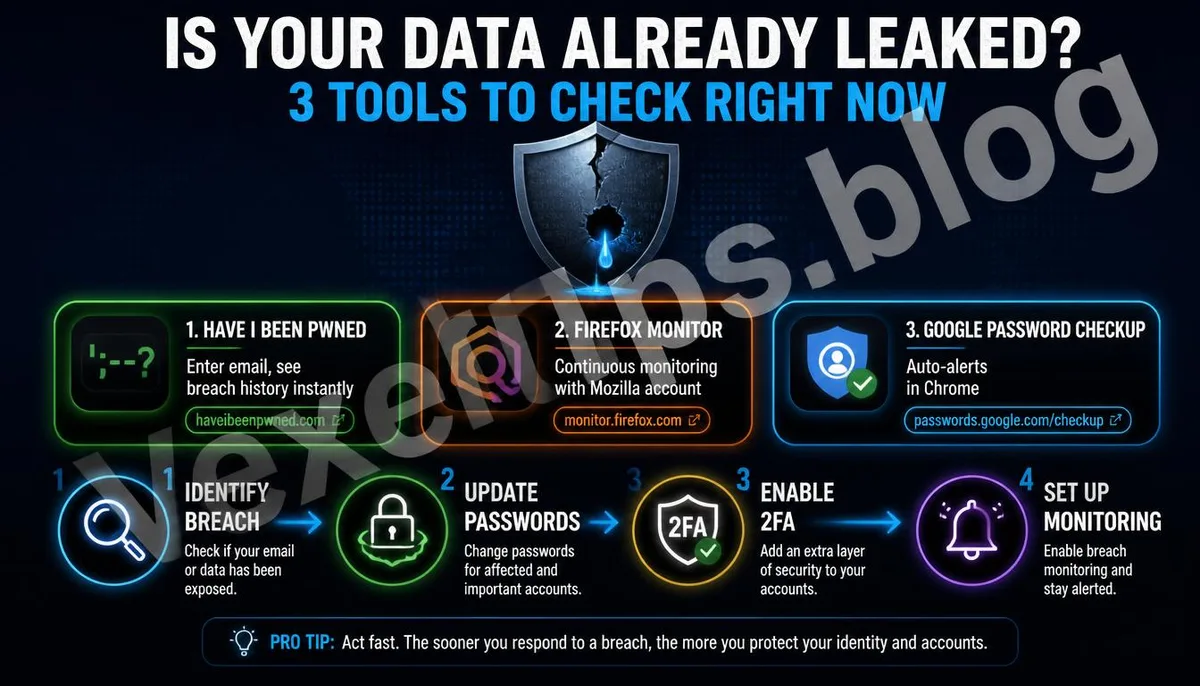
Upon Discovering Your Account Data Has Leaked, Follow This Order to Address It After finding a leak result, there's no need to panic, but you should handle it in order. Confirm the Service and Type of Affected Data Clearly see which service experienced the leak and what types of data it involved. If it was just your email address, the risk is relatively limited. If it includes a password, immediate action is necessary. Change the Password for the Affected Service Go to that service and immediately change to a brand new strong password that should not be used elsewhere. Check for Other Services Using the Same Password If you use the same password across multiple services, all of them need to be changed. After an attacker obtains a set of account credentials, they typically try to log into other common services; this method is known as credential stuffing. Enable Two-Factor Authentication for the Affected Service After changing passwords, confirm that two-factor authentication is enabled. This means that even if the password leaks again, attackers cannot log in solely with the password. Further Reading: How to Choose a Password Manager? Comparison and
Frequently Asked Questions about Data Leak Queries
Is it Safe to Enter My Email into Have I Been Pwned? Does this Site Collect My Data?
Have I Been Pwned is one of the most reputable tools in the cybersecurity community, personally maintained by Troy Hunt, who has a strong reputation and public record in the security industry. The site does receive the email address you input during the query, but Troy Hunt has publicly stated on multiple occasions that the site does not save or sell query records. If you still have concerns, you can opt to use Firefox Monitor, which offers similar functionality and is backed by Mozilla, a more formally structured organization. Alternatively, you can directly check the built-in leak reminder feature of Google Password Manager without entering your email into any third-party sites.
The Query Results Say My Data Has Leaked, But I Haven't Used That Service in a While; Do I Still Need to Act?
Yes, but the priority can be judged based on the situation. The most important confirmatory point is whether the password you used for that service is the same as the one you currently use for other services. If they are the same, even if you no longer use that service, this password still poses a risk and must be changed across all services still in use. If the service is a standalone password that you no longer use and the leak only involved the email address, the actual risk is relatively limited. However, this email may receive more spam or phishing emails since it has entered various marketing and scam lists.
My Account Data Has Leaked; Can Attackers Log Into My Account Right Now?
It depends on the type of leaked data and the current security status of your account. If the leaked data includes your password and your account does not have two-factor authentication enabled, theoretically, someone with that data could attempt to log into your account. However, there is usually a time gap between when data leaks and when it gets exploited. Leaked data takes time to circulate on the dark web and be acquired and utilized by various attackers. If you change your password immediately after discovering a leak and enable two-factor authentication, you can effectively block this risk path in most cases. There is no need to assume your account has already been breached, but you should not delay taking action.
One Key Takeaway: Data breaches are not always something you can prevent, but how you handle them quickly after discovery is something you can control. Have I Been Pwned makes this verification process take just a few minutes, and changing affected passwords and enabling two-factor authentication are the two most direct steps to minimize subsequent risks.