
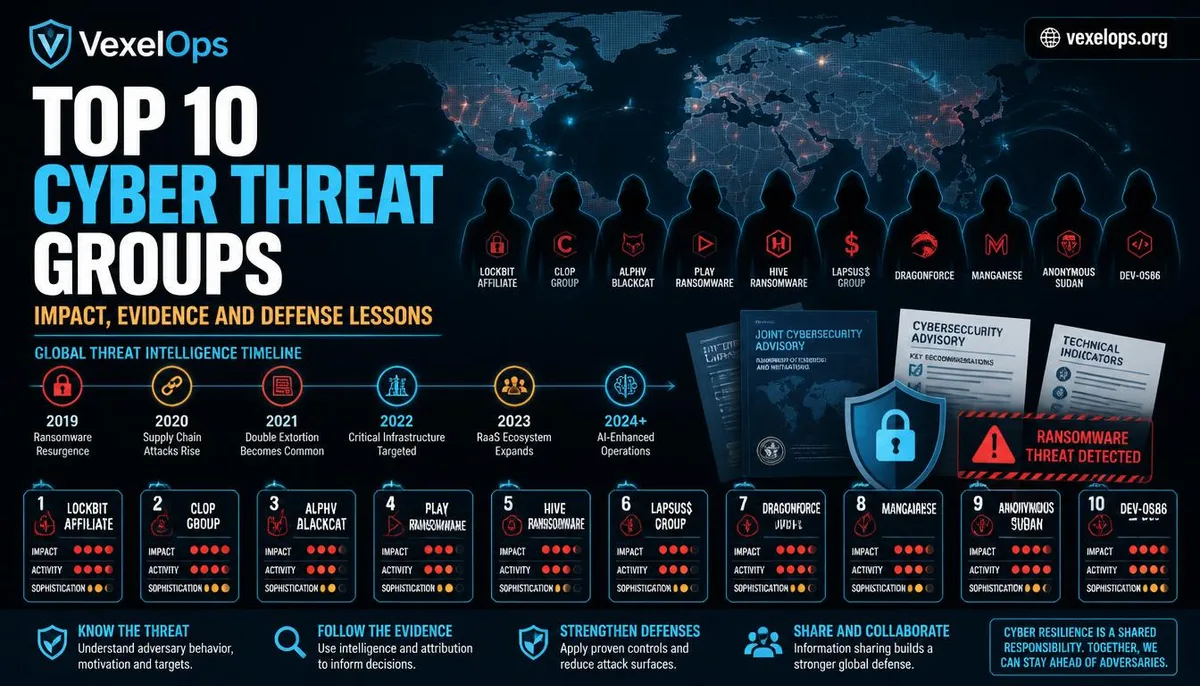
How are hacker organizations ranked? First, understand this is not a power ranking.
The names of hacker organizations often come from government announcements, cybersecurity company reports, investigations of victim incidents, or research communities. Sometimes, the same actor may be described by different agencies under different names; at other times, several names may represent the same group, or may just reflect overlapping activities that have not yet been definitively attributed. Therefore, when reading rankings, one should not rely solely on a single alias or mysterious rumors online. This article uses five criteria: whether public data is verifiable, the scope of event impact, whether activities are ongoing, the affected industries and infrastructures, and whether the general reader can learn defensive methods from the events. The ranking reflects public influence and educational value, not an assessment of attack capability. The threat groups in this article do not represent that all member identities have been confirmed by judicial authorities. For attributions in public data that remain contentious, this article uses accurate expressions such as suspected, attributed, as reported publicly, or referred to.
Top 10 Cyber Threat Groups: Public Events and Organizational Characteristics
Top 1: LockBit, Representative of Ransomware as a Service
CISA, FBI, and international collaborative agencies have issued specific announcements about LockBit, indicating that LockBit employs a Ransomware-as-a-Service model and affects various sectors, including finance, food and agriculture, education, energy, government, healthcare, manufacturing, and transportation. CISA LockBit Announcement LockBit's significance lies not only in a single ransomware version but also in demonstrating how criminal activities can expand impact through division of labor, recruitment of collaborators, and service-oriented models. For businesses, the core lesson is that offline backups, patching exposed services, limiting privileges, network segmentation, and incident reporting cannot rely solely on a single product.
Top 2: APT29, Representative of State-Sponsored Cyber Espionage
MITRE ATT&CK describes APT29 as a threat group associated with the Russian Foreign Intelligence Service SVR, recording its long-term targeting of government networks, research institutions, and think tanks. MITRE ATT&CK: APT29 APT29-type threats are typically characterized by their long-term nature, resourcefulness, and intelligence orientation, differing from criminal groups that seek quick ransomware. Ordinary readers do not need to learn their action techniques, but organizations should understand the importance of supply chain security, cloud permissions, third-party accounts, and monitoring long-term anomalous activities.
Top 3: Scattered Spider, Representative of Social Engineering and IT Service Desk Risks
Joint announcements from CISA, FBI, and multiple national agencies note that Scattered Spider has targeted large enterprises and their IT service desks, involving data theft, extortion, and various social engineering risks. CISA Scattered Spider Announcement This organization case is particularly noteworthy for the general reader as it reminds people: attacks do not always begin with complex code but may start with impersonating employees, pretending to be customer service, urging password resets, or inducing individuals to disclose verification information. Defense focuses include anti-phishing multi-factor authentication, service desk identity verification, and denial of sharing one-time verification codes.
Top 4: Conti, A Case of Ransomware Massification
Public data from the NSA indicates that CISA, FBI, and the NSA have observed over 400 attacks using Conti ransomware against U.S. and international organizations; relevant actions involve data theft, system encryption, and extortion requests. NSA Conti Announcement The Conti case shows that ransomware incidents are typically not just a single computer being locked but may involve accounts, servers, backups, internal networks, and data breaches. For ordinary users, an important lesson is to keep multiple backups of important files and avoid placing the only backup in the same account that is permanently connected.
Top 5: Lazarus Group, Representative of Cross-Category State-Sponsored Threats
The Lazarus Group is often used by cybersecurity agencies and government data to describe cyber threat activities linked to North Korea. Public reports typically associate it with espionage, financial resource acquisition, destructive activities, or high-value targets, but attributions and names may vary depending on the evidence presented in different reports. The educational value of such organizations lies in the understanding that cyber threats may have intelligence, financial, and political motives, and should not be judged solely based on general scams or isolated ransomware incidents. Enterprises should enforce stricter permissions and monitoring regarding high-value accounts, remote access, supply chain, and crypto assets.
Top 6: APT28, A Public Case of Long-Term Intelligence Operations
APT28 is a frequently mentioned name in public cybersecurity data, often discussed alongside state-sponsored activities associated with Russia. Such organizations may target governments, military, political institutions, media, and research organizations, with long-term intelligence gathering as the main risk background. Readers do not need to remember all aliases but should understand that state-sponsored actors may be lurking long-term and do not necessarily reveal themselves immediately, as with ransomware. Organizational defenses should emphasize monitoring unusual logins, permission changes, email rules, supply chain, and endpoint records, rather than waiting for visible ransom notifications.
Top 7: Sandworm, Representative of Critical Infrastructure Risks
Sandworm is often used in public cybersecurity research and government data to describe threat activities related to destructive cyber actions. These threats are significant because the impact on energy, industrial control, government services, and public infrastructure can exceed the data breaches of single enterprises. From this, the general user can understand that cybersecurity and daily life are interconnected. Transportation, healthcare, energy, and communication systems rely on information system operations, so organizations need layered defenses, offline backups, incident drills, and inter-agency reporting capabilities.
Top 8: FIN7, Representative of Financial Crimes and Corporate Intrusions
FIN7 is a well-known name in public cybersecurity reports related to financial crime threat organizations, with relevant activities usually associated with payment data, retail, corporate networks, and financial interests. These groups remind us that attackers do not always target governments or large tech companies; small to medium enterprises possessing payment data, customer information, or internal access rights can also become targets. Businesses can learn from such incidents that payment processes and information security need to be jointly managed. Payment permissions should be layered, important operations require multiple confirmations, and employees should be aware that fraudulent invoices, fake vendors, and unusual payment requests may simultaneously involve social engineering and account takeover.
Top 9: REvil, A Notable Case of Ransomware Alliances
REvil was one of the ransomware groups widely discussed in public cybersecurity incidents, often used to illustrate how ransomware can increase pressure through collaborative members, data leak threats, and various extortion methods. As cybercrime organizations may disband, rename, or reassemble with different members, the article should not attribute every new event directly to the same name. For businesses, the practical lesson from these cases is to establish incident response processes that can be utilized offline. When primary email, file servers, or identity systems become unusable, organizations still need to know how to contact internal personnel, preserve evidence, activate backups, and communicate externally.
Top 10: DarkSide, A Defensive Warning After Major Ransomware Incidents
DarkSide gained attention due to its connection with significant ransomware incidents discussed publicly. It represents a type of cybercrime risk that uses business operation disruptions, data breaches, and reputational pressure as its means. Even if a particular organization later ceases operations, related programs, members, methods, or collaborative models may still appear under different names. This case reminds ordinary users and businesses not to assume that the disappearance of a well-known group signifies the permanent end of risk. A reliable security strategy should be based on fundamental controls, including updates, backups, multi-factor authentication, endpoint protection, least privilege access, and testable recovery processes.
How Do Hacker Organizations Affect Businesses, Governments, and Ordinary Users?
Different threat groups may have different targets, but the common risks faced by victims can be categorized into four types: account takeover, data theft, service disruption, and being pressured for payment or exposure of data. The tools and names used by attackers may vary, but weak passwords, excessive permissions, unpatched systems, lack of backups, and misplaced trust remain common sources of risk. Ordinary users can glean a few simple lessons from organizational incidents. Important accounts should use unique passwords and anti-phishing multi-factor authentication; never share one-time verification codes with anyone; when receiving requests for remote control or emergency payments, confirm through another trusted channel; important files should be backed up offline and not connected simultaneously to daily accounts. If you have questions about hacker organizations or cybersecurity incidents, you can contact VexelOps for assistance.
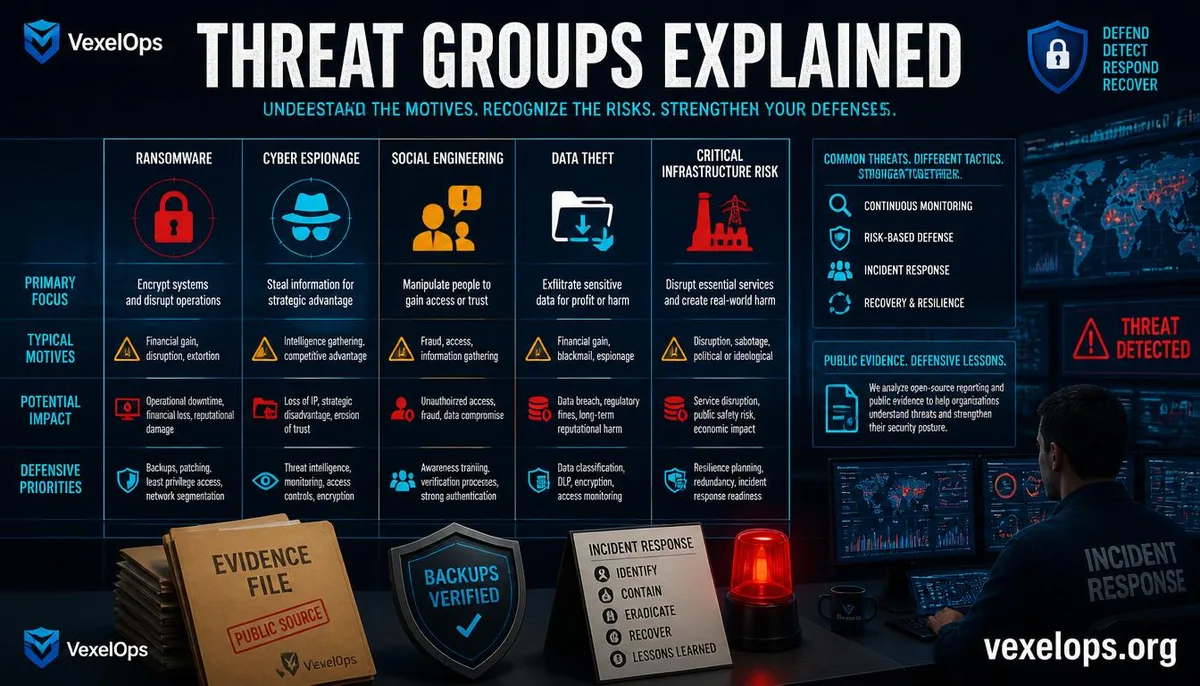
Frequently Asked Questions about Hacker Organization Rankings
Is this Top 10 a globally recognized ranking of hacker organizations?
No. The names, attributions, and activity statuses of cyber threat organizations may change with government investigations, cybersecurity reports, and new evidence. Different agencies may also describe the same or similar activity clusters using different names, creating no objectively recognized power ranking. This article is an edited compilation based on public data, event impact, activity continuity, industry risk, and educational value for defenses. Readers should view it as an introduction to cybersecurity background, rather than interpreting the rankings as endorsements or idolization of any criminal group.
Are hacker organizations and fraud groups the same?
Not necessarily. Hacker organizations typically emphasize technical roles, network infrastructure, malicious software, or system intrusion capabilities; fraud groups primarily rely on impersonation, deception, manipulation of trust, and inducing payments. While both may collaborate, they are not the same category. The general public does not need to determine which organization the other party belongs to before taking defensive actions. If someone requests passwords, verification codes, remote control permissions, or immediate payments, interaction should cease, and confirmation should be sought through official websites or independent channels.
What should ordinary people do upon seeing well-known hacker organization names?
First, verify the source of the information; do not trust only social media screenshots, anonymous accounts, or posts claiming insider knowledge. Prioritize checking government cybersecurity announcements, official notifications from affected platforms, and credible cybersecurity research, while taking note of the announcement publication dates and whether they have been updated. If you are concerned that your account or device may be affected, consider changing reused passwords, enabling multi-factor authentication, checking login activity, updating systems, and preserving relevant notifications. Do not download so-called repair tools provided by strangers, and do not disclose verification codes to individuals claiming to be security personnel.
One Key Takeaway: The key focus of this ranking is public impact and defensive lessons, not to encourage or idolize criminal groups.