

Google Searches for Web Pages, Shodan Searches for Devices
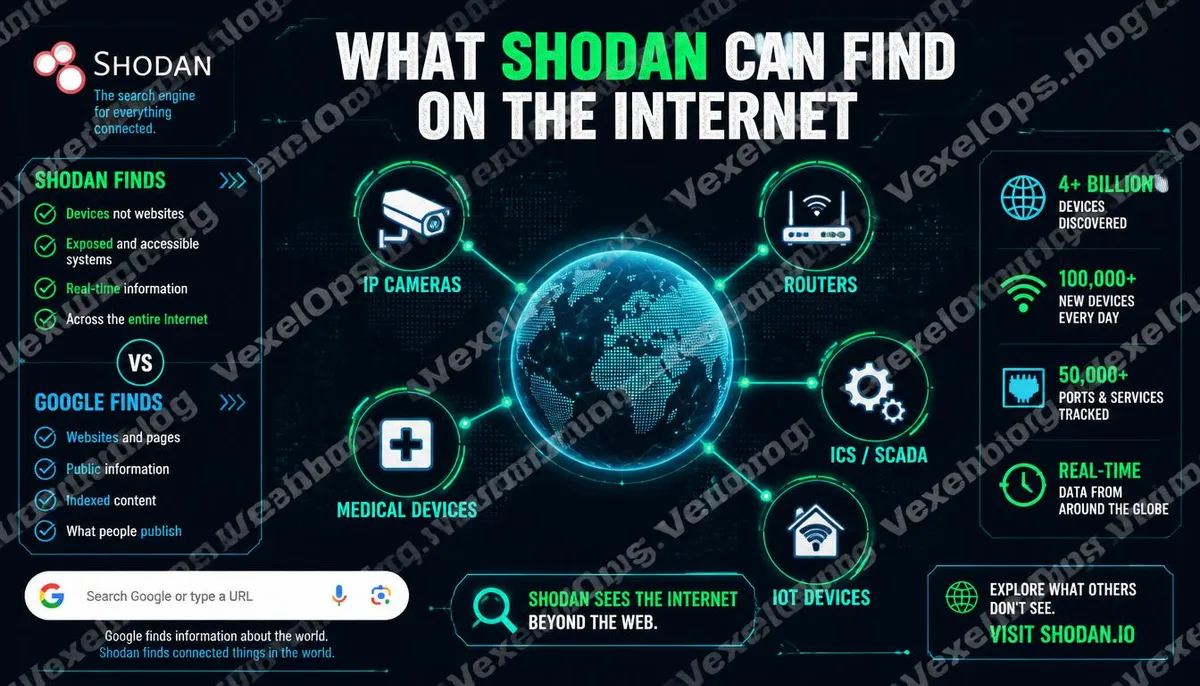
The search engine most people understand finds relevant web content by inputting keywords. What Shodan does is fundamentally different; it does not search for web pages but rather for devices connected to the internet itself. Shodan operates by continuously scanning IP addresses on the internet, attempting to connect to various ports, and recording information about device responses such as device type, operating system used, open services, and occasionally device names and location information. This data is organized into a searchable database that anyone can query through Shodan's website. This is also why it is referred to as a hacker search engine, as it makes searching for devices exposed on the internet as easy as searching for information on Google.
What Types of Devices Can Shodan Find?
The range of devices indexed by Shodan is quite broad, including types that a typical user might not imagine:
- Home and business surveillance cameras, some still using default passwords or completely lacking authentication
- Home routers and network devices, exposing model and firmware version information
- Industrial control systems and SCADA devices, some managing power, water treatment, or manufacturing facilities
- Medical devices, including some connected imaging devices or patient monitoring systems
- Web servers, database servers, sometimes including public access interfaces due to misconfiguration
- Smart appliances and IoT devices, such as smart TVs, printers, and access control systems
These devices appear on Shodan not typically because they have been hacked, but because they are inherently connected to the internet without sufficient access restrictions. Shodan merely organizes this inherently public information.
How Information Security Professionals Use Shodan
In an information security work context, Shodan is a tool for assessing network exposure. A company's security team uses it to search their organization's IP range to verify which services are inadvertently exposed to external networks or which devices are using known vulnerable outdated firmware. Penetration testers also use Shodan as part of the preliminary information gathering when conducting authorized security assessments to understand the external network exposure of the target organization before deciding the direction of further testing. For researchers, Shodan provides a perspective to observe the global state of IoT security; in recent years, several studies analyzing the network security status of industrial equipment and medical devices have used Shodan's data as a basis for analysis.
Should Ordinary Users Worry About Shodan?
If the router you use at home is configured correctly, firmware is kept up to date, and unnecessary services are not exposed to external networks, then the direct risks posed by Shodan are relatively limited. Shodan itself is just an indexing tool; it displays information about devices that are already public on the internet and does not actively invade any devices. What is really noteworthy is that some home devices indeed expose unnecessary information or access interfaces by default. If you want to check if your home network devices appear in Shodan's search results, you can query your external IP address to confirm. This external IP can be obtained through a Google search for your current IP, then search that on Shodan to see what information is displayed. If you find that your device appears on Shodan and shows services or interfaces that should not be public, it is advisable to contact your ISP or the technical personnel responsible for managing the device for confirmation. VexelOps can also assist in assessing the risk level of this information and whether further action is needed.
Shodan FAQs
Is it legal to use Shodan to search for others' devices?
In most regions, querying publicly exposed device information via Shodan is not illegal, as Shodan indexes only information that devices actively respond with publicly. However, further attempts to log in, access, or control these devices enter the realm of unauthorized access, which is illegal in the vast majority of regions. Shodan is a legitimate tool in cybersecurity research and educational contexts, but its legality is determined by how it is used.
What is the relationship between Shodan and Google Hacking?
Google Hacking refers to using Google's advanced search syntax to find sensitive information inadvertently exposed on the internet, such as open directory listings or documents containing account information. The concepts are similar; both utilize publicly searchable information to uncover potential security issues, but Shodan targets devices on the network level while Google Hacking tends to focus more on web content. In information security assessments, these two methods may sometimes be used in tandem.
What is the relationship between IoT device security issues and Shodan?
Shodan is not the cause of IoT device security issues; it merely makes these issues more easily observable. Many IoT devices prioritize usability over security in their design, having default passwords, unnecessarily open ports, and a lack of update mechanisms, which are the fundamental issues. Shodan's existence allows security researchers to systematically assess the scale of these problems and makes it more difficult for device manufacturers to overlook the existence of these security gaps. One Key Takeaway: Shodan makes it easier to search for devices exposed on the internet. Its existence serves as a reminder that any device connected to the internet should be treated as an entry point that requires active management of its security status, rather than simply a tool that can be plugged in and ignored.