

Can a screen really access any account?
You might have seen videos showing a black terminal quickly displaying a few lines of text, followed by a password, a login page, or a system that appears to be under control. The videos do not explain whether the target has given consent, nor do they clarify the testing environment, but they create a direct impression: installing Kali Linux can crack any password. This impression is appealing but can also be misleading. Kali Linux is not a magical tool that can break through all systems with a push of a button. It is more like a well-organized security research platform that allows professionals to perform checks, document issues, and suggest fixes in an authorized environment.
What is the real purpose of Kali Linux?
Kali Linux is officially described as a Debian-based open-source Linux distribution, primarily used for penetration testing, security research, computer forensics, and reverse engineering. It integrates a variety of cybersecurity tools, allowing security professionals not to start from scratch with the installation and configuration of each tool. The official documentation emphasizes that the value of Kali Linux is not just the tools themselves, but the complete platform and workflow. From information gathering and vulnerability analysis to the final report compilation, these processes require users to understand the systems, define the scope, interpret results, and suggest remedies. Thus, Kali Linux can be used to check one’s own lab, agreed-upon company systems, intentionally designed training environments, or other legal testing targets. It cannot automatically turn unauthorized targets into legally permissible ones.
What is the difference between password cracking and password security testing?
The goal of password security testing is to understand how a system handles weak passwords, reused passwords, leaked passwords, and insecure login processes. Testers typically need to obtain explicit authorization from asset holders, confirming the testing scope, time, data handling methods, and reporting processes. The simplified portrayal of cracking passwords in online videos may actually involve multiple steps such as confirming the testing target, checking password policies, observing login protections, analyzing risk results, and proposing remediation. This work does not equal gaining access to a stranger's account and does not suggest that tools can handle all encryption methods. Legal testing generally adheres to the following principles:
- First confirm the target, testing scope, authorized person, and allowed testing time.
- Use isolation environments or clearly authorized testing systems, avoiding unknown accounts and public devices.
- Only collect data necessary for completing the tests and protect information seen during the testing process.
- Aim to mitigate vulnerabilities and lower risks, rather than demonstrating invasion visuals.
Truly valuable security testing is not about showcasing a tester's ability to access a system but about informing the system owner where the problems lie and how to mitigate risks.
Hackers, cybersecurity researchers, and scammers are not the same people
A hacker is a technician with programming, system, or network skills. The term itself does not equate to criminality. Cybersecurity researchers, penetration testers, system administrators, and educators may all use similar tools to understand how systems work. Scammers, on the other hand, profit from fake cracking services, fake courses, fake tools, or guaranteed invasion results. They may claim that for a fee, they can crack a certain account, or request users to provide passwords, validation codes, tokens, or remote control permissions. If someone on social media promises they can crack strangers' accounts, view others' private messages, or guarantees breaking through any password in minutes, these claims are inherently suspect. The existence of Kali Linux does not make these promises automatically credible. VexelOps can help organize sources of security tools, test authorization scopes, suspicious cracking service information, and timelines of events, allowing readers to differentiate between legitimate security research and scam promises before learning or seeking support without disclosing accounts or remote control permissions.
If I want to learn Kali Linux, how can I start without falling into risks?
Beginners should first understand the basics of Linux, network concepts, system permissions, data protection, and testing ethics before diving into tools. Practice can be conducted using personal virtual machines, deliberately designed vulnerable environments, legally compliant cybersecurity training platforms, or systems where testing is explicitly permitted. While learning, one can establish a few basic habits:
- Before any testing, confirm the target, scope, time, and authorization records.
- Use isolated virtual machines or dedicated testing environments, avoiding placing unfamiliar tools directly into primary working devices.
- Do not test real accounts, unknown websites, public devices, or networks that do not belong to you.
- Preserve test notes and results but do not collect unnecessary personal data.
- Aim to solve problems rather than to showcase invasion visuals.
The learning value of Kali Linux lies in establishing a security mindset. Understanding what a tool can do, and what it cannot reasonably do, is the true beginning of comprehending penetration testing.
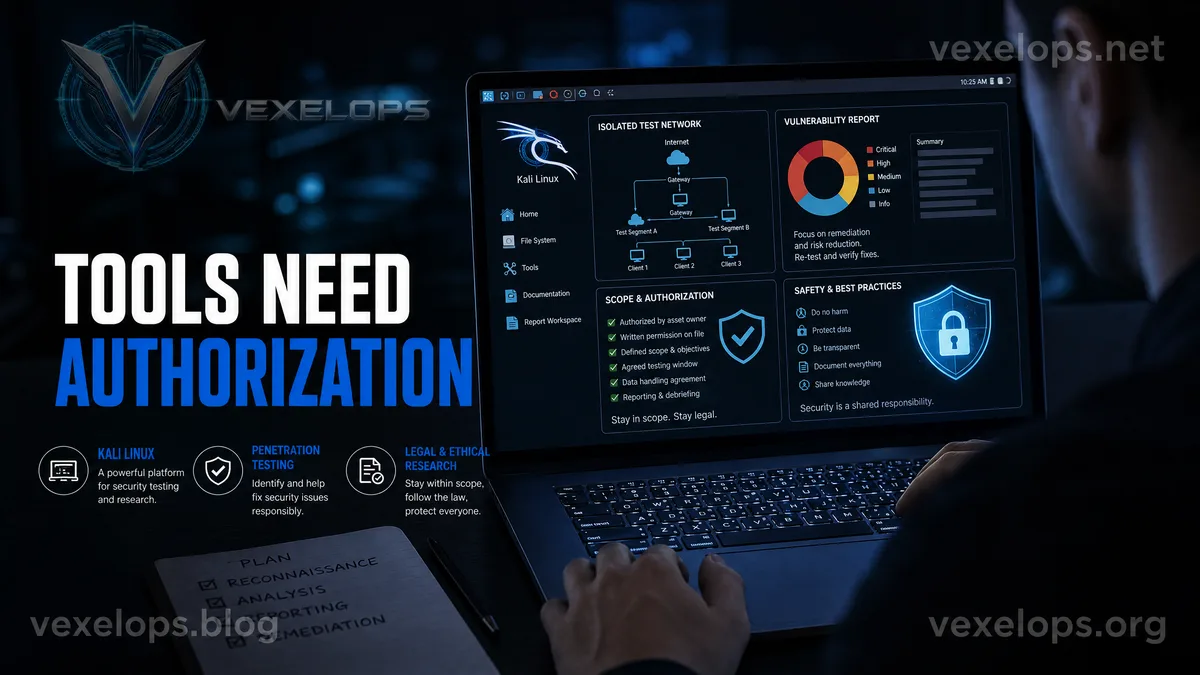
Common Questions About Kali Linux and Password Cracking
Can Kali Linux directly crack any password?
No. Whether a password can be guessed or tested depends on the password itself, the encryption method, login restrictions, validation mechanisms, system configurations, and testing scope. Kali Linux provides the platform and tools but does not automatically eliminate these technical conditions. More importantly, testing accounts or systems that do not belong to you does not become legal simply by using Kali Linux. Learners should use their experimental environments or clearly authorized training targets and not directly apply demonstrations from online videos to real accounts.
Does using Kali Linux mean the user is a hacker?
Not necessarily. Kali Linux can be used by cybersecurity personnel, researchers, students, system administrators, and educators. The tool's purpose depends on the user's goals, authorization, and behavior, not solely on the operating system's name. Similarly, genuine security work often involves planning, documenting, risk communication, and remediation rather than simply terminal displays. If someone guarantees they can crack all accounts with just a few screen shots, without discussing authorization and data protection, skepticism is warranted.
Should ordinary people install Kali Linux?
If someone is only browsing the web, doing office work, or gaming, it is typically unnecessary to install Kali Linux on their primary computer out of curiosity. Its tools and configurations are oriented towards security research, which may increase risks of misoperation and data exposure for users without a basic understanding. If you want to learn, start by reading official documentation, using virtual machines, or legally compliant practice platforms. Begin with the basics of Linux, networks, and password security. Learning to protect your own systems before understanding security testing tools is often more reliable than rushing for quick cracking visuals.
One Key Takeaway: Kali Linux is a security testing platform, not a magic tool for cracking any password; what truly matters is authorization, isolated environments, and fixing issues.