
Can You Really Find Anything After Turning Off Your Phone?
There is a belief circulating online that simply turning off your phone makes you instantly invisible, rendering all tracking technologies ineffective. This notion seems intuitive; after all, when the phone is off or out of power, it theoretically should stop sending signals. However, the reality is a bit more complex, involving several layers of technology behind phone tracking. To determine if a phone can still be tracked after being turned off, we must first understand how phone tracking typically works.
How is Your Phone Normally Tracked?
The tracking capability of a phone is not achieved through a single technology; rather, it combines several methods that interact with each other, functioning under different circumstances. The first method is base station location. This is the fundamental mechanism of mobile communication. As long as the phone is powered on and has a SIM card inserted, it continuously maintains a connection with nearby telecom base stations, which is essential for making calls and sending texts. Telecom companies can estimate the general area where the phone is located by analyzing the signal strength and angle between the phone and multiple base stations. This method typically has an accuracy range of several hundred meters to several kilometers, varying depending on the density of base stations – in urban areas, accuracy tends to be higher. The second method is GPS satellite location, which requires the phone to have location services enabled and specific apps requesting location information. It calculates precise coordinates by receiving satellite signals, achieving accuracy within a few meters. This method does not rely on telecom service providers, but the phone must be powered on with
So, Do These Tracking Methods Function When the Phone is Turned Off?
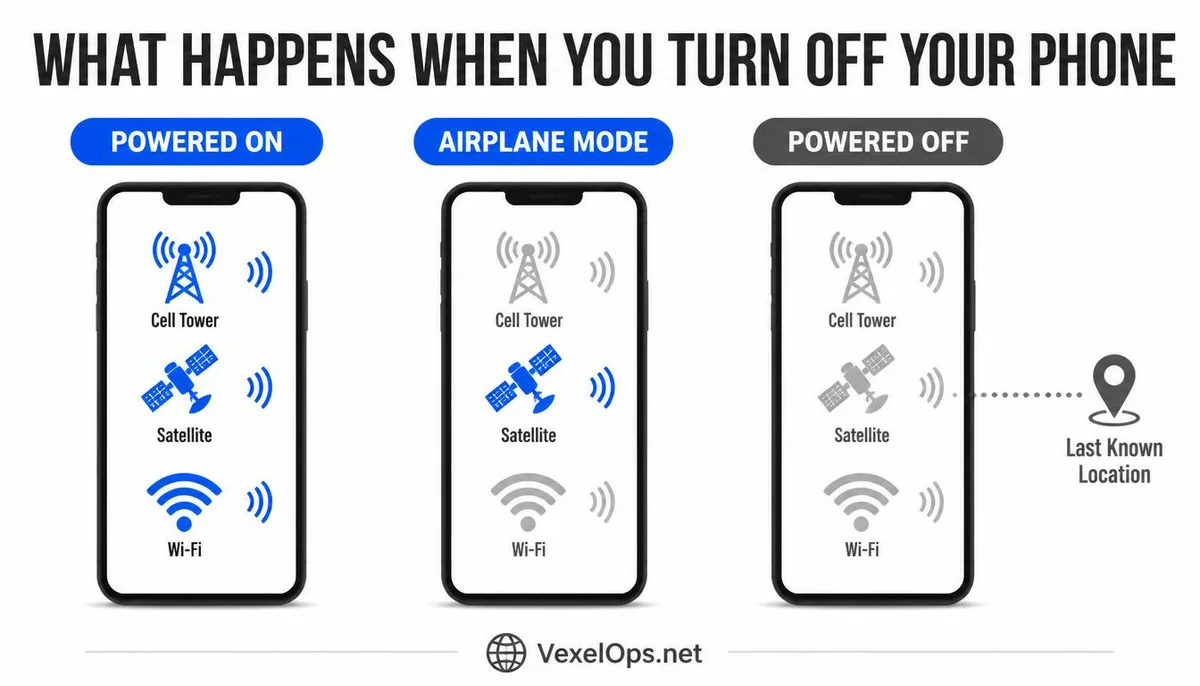
Under typical circumstances, when the phone is completely turned off, all functions such as base station connections, GPS signal reception, and Wi-Fi or Bluetooth scanning cease to operate, as the communication chips and antennas do not transmit or receive signals in an off state. However, there are two exceptions worth noting. The first is the last recorded location prior to shutdown. At the moment of turning off, the phone usually saves the last successfully located position in the system or in the cache of specific apps, like Apple’s Find My or Google’s Find My Device. Even if the phone is off, this last recorded location will still be displayed on the corresponding account interface – it reflects the position at the moment of shutdown, not real-time status post-shutdown. The second is the low-power search function. Recently released iPhones can still use Bluetooth low-energy signals to allow other nearby Apple devices to report a general location even when the phone is turned off. This function is designed to provide a way to recover the phone if it gets lost, stolen, or runs out of battery. However, this feature will only work if the phone supports it and has enough
What Should Users Really Be Concerned About?
Having understood the principles above, it’s clear that turning off a phone does greatly reduce the likelihood of real-time tracking. Yet, this doesn’t guarantee absolute invisibility at all times, especially in devices equipped with low-power search features. For the average user, rather than getting caught up in the technical details of what happens at shutdown, there are more practical steps to take. Regularly check the list of apps with location permissions on your phone and revoke permissions for those that do not require constant tracking. Pay attention to whether anyone other than yourself has access to device-finding features associated with your accounts, particularly in situations where Apple IDs or Google accounts are shared. This approach is far more relevant to daily risks than merely researching whether a phone can be tracked when shut off.
Common Questions Users Ask About Phone Tracking
Is Airplane Mode the Same as Turning Off?
Not entirely. Airplane mode disables the phone’s mobile network, Wi-Fi, and Bluetooth connections, preventing it from communicating with base stations or wireless networks, which is similar to turning it off. However, the phone remains powered on in airplane mode, allowing GPS chips to operate normally in certain models; they just can’t transmit results over the network in real-time. In other words, airplane mode primarily blocks signal transmission, not the functioning of the GPS chip itself.
Will Removing the SIM Card Prevent Tracking?
Removing the SIM card can stop the phone from connecting and being tracked through the telecom provider's base station network, which is effective. However, if the phone connects to Wi-Fi at home or in public places, it can still be tracked approximately through that network, and GPS can operate without a SIM card. Removing the SIM card only blocks one form of tracking and is not a comprehensive solution.
Why Does My Friend Say Their Phone Still Shows on Find My After Turning Off?
This situation usually relates to the previously mentioned low-power search functionality. If the device supports this feature and has sufficient battery, it may still report an approximate location using Bluetooth signals from nearby devices after being turned off. Another common possibility is that what is being displayed is actually the last known location before shutdown, not a real-time location; the screen usually indicates the last seen time, and checking the timestamp can clarify whether it’s a current position or a historical record.
One Key Takeaway: Once the phone is turned off, most real-time positioning functions do stop, including cell tower connections, GPS signal reception, and Wi-Fi and Bluetooth scanning. However, two easily overlooked exceptions are the low-power finding mechanisms available in some newer devices and the last recorded location retained before the phone is turned off. Instead of getting caught up in the technical details of the moment the phone is turned off, regularly checking the App's location permissions and account device access status is a more practical way to protect yourself.