

Lost a Game, Opponent Claims to Know Your IP
During an online game, a dispute arises and your opponent suddenly threatens, 'I have your IP, just wait and see.' Many people have encountered this situation. The typical reactions are polarized: one may dismiss it as a joke, while another may become anxious, worrying about a possible threat. To assess the validity of such a threat, it’s essential to understand what an IP address can actually reveal and what parts may be exaggerated.
What Is an IP Address Anyway?
Every device connected to the internet requires an IP address, which acts like a delivery address for postal services to know where to send packets of data. There are two ways to obtain an IP address: a public IP assigned by an ISP when a device connects to the internet, or a private IP used within a local network, which usually isn’t visible externally. Most homes and businesses utilize dynamic IP addresses, which means the IP can be reassigned periodically or every time the router reconnects, so it’s not permanently tied to a single person.
What Can Someone Find Out If They Have Your IP?
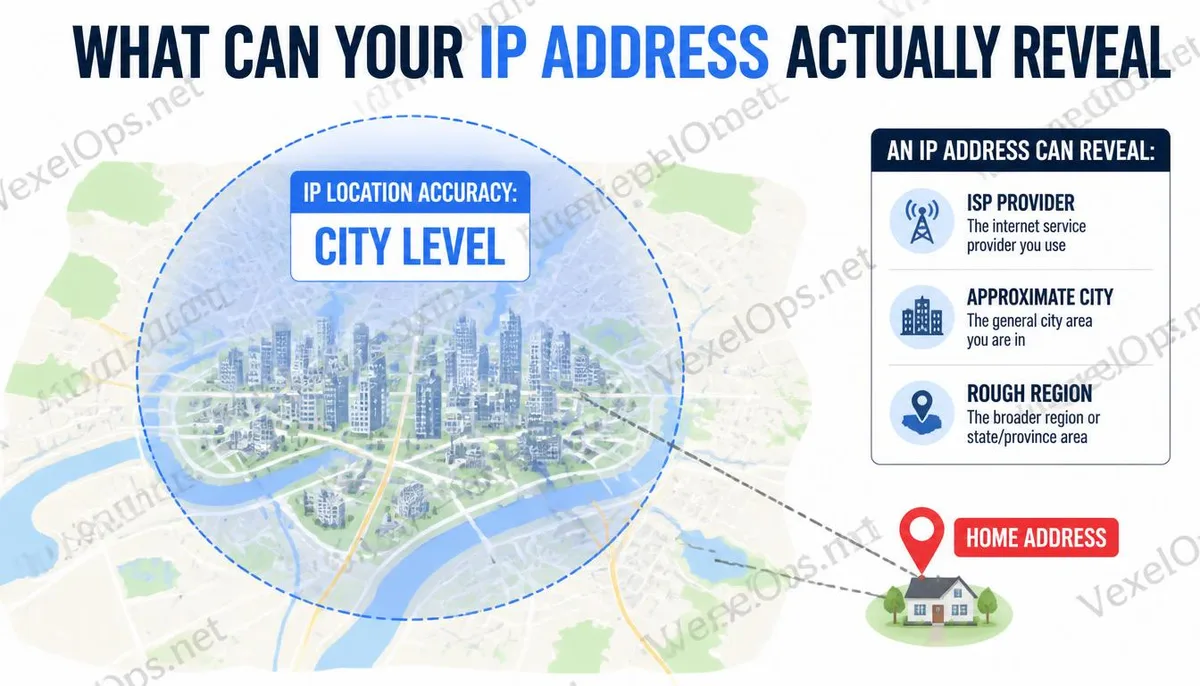
Using IP lookup tools, anyone can indeed retrieve some information, which is a factual reality. This includes the ISP the IP belongs to, a rough location (city or region), and sometimes approximate latitude and longitude coordinates. However, there’s a critical gap: the geographical location displayed by IP lookup tools is usually based on the location of the ISP's servers or routing nodes, which can be significantly different from the user’s actual home address. The range might cover an entire city or even cross administrative districts; it cannot pinpoint exact house numbers. In other words, while someone may find out which city you live in, it’s technically impossible to walk to your front door using just your IP address.
Why Do Some Cases Seem Like IP Can Really Locate Someone?
This misunderstanding often arises not from relying solely on the IP address, but from a combination of clues gathered through other channels alongside the IP. For example, an opponent might know your publicly shared social media check-in locations, school or workplace details, or specifics disclosed by mutual friends. These combined clues can create a seemingly accurate location, rather than the IP address itself providing this information. There are also instances where law enforcement requests user data from ISPs using an IP address, a process that requires legal protocols and cooperation from the provider; generally, individuals do not have the means or authority to do this. Understanding this gap allows for a more rational assessment of the actual weight of statements like, 'I know your IP.'
If You're Concerned About Your IP Being Exposed, What Can You Do?
If you feel uneasy about such threats or require higher online privacy for work, there are several practical options: Using a VPN can hide your actual IP address, displaying the VPN provider’s server IP instead. This is the most common and user-friendly approach. Avoid using outdated versions of tools in live streams or voice chat applications that could exploit vulnerabilities to find your real IP. Regularly updating to newer versions helps fix these kinds of data leak issues. Minimize sharing specific life details on social media, such as real-time check-ins or consistent exercise routes. Seemingly unrelated bits of information can often reveal more about your real location than the IP address itself. If your home router allows it, regularly restarting your router or contacting your ISP to change your IP address can minimize the chance of being continuously linked to the same IP address.
Common Questions Users Ask About IP Address Exposure
Someone Claims They Will Use My IP for a DDoS Attack. Is This a Real Threat?
DDoS attacks do technically exist and do require knowing the target's IP address to be executed. However, initiating them usually takes a certain level of technical resources and tools, and cannot simply be done casually. Most individuals who throw around such threats during disputes do not possess the ability or resources to carry out such attacks; it's usually more of a psychological tactic to intimidate. If you receive consistent and credible threats, it’s advisable to keep a record of your conversations and report them without panicking.
I Usually Use Mobile Data; Can My IP Still Be Tracked?
Mobile network IP addresses tend to change more frequently than those for home fixed-line broadband because ISPs dynamically allocate and reclaim IP addresses. The same IP address might be used by different users within a short timeframe. This means that even if an IP address is tracked at a specific time, it won’t necessarily remain associated with the same individual long-term. However, it doesn’t mean you can be completely at ease; mobile users may still be tracked due to extended sessions of connectivity.
Does Using a VPN Mean I'm Completely Safe and My Real IP Can't Be Traced?
A VPN effectively conceals your real IP address, showing the VPN server's IP to outsiders, which suffices for most scenarios. However, it’s essential to investigate whether the VPN provider keeps logs of user activity. If they retain comprehensive connection logs, these records could potentially be required under specific legal circumstances. Opting for a VPN provider with a clear no-logs policy is a crucial step when using VPNs.
One Key Takeaway: An IP address can indeed reveal the general city or area where you are located, but it cannot precisely pinpoint your home address solely based on the IP address; there is a significant gap in accuracy. What really needs to be noted is the risk posed by combining an IP address with publicly available information from social media platforms, rather than the IP address itself.