
A Set of Account Passwords May Seem Worthless, But It's Not That Simple
Most people's judgment of their account information's value likely goes something like this: I'm not a celebrity, and there's nothing valuable in my account—who would want it? This intuitive thought is precisely why many people neglect to protect their account security. In reality, there is indeed a trading market for personal data and account information, and its scale is larger than most people imagine, with operations more organized than expected. Understanding how this industry chain generally works will clarify why protecting a seemingly ordinary set of account passwords is not an overreaction.
How Does This Information Flow into the Black Market?
Account information typically flows into the black market through several channels. 1. Large platforms or service providers experience data breaches, where a single breach may involve millions of account data. Such incidents have occurred on many well-known platforms in the past, and the leaked databases are bundled and sold through specific channels. 2. Phishing websites or fake login pages trick users into entering their account passwords voluntarily. This information is usually more precise, as the gatherers obtain the current status of the user's account simultaneously. 3. After a device is infected with trojan programs or malware, it continuously records the account passwords entered by the user, often capturing real-time and complete information, including login credentials for multiple platforms.
The Price Difference for Different Types of Accounts Is Actually Quite Large
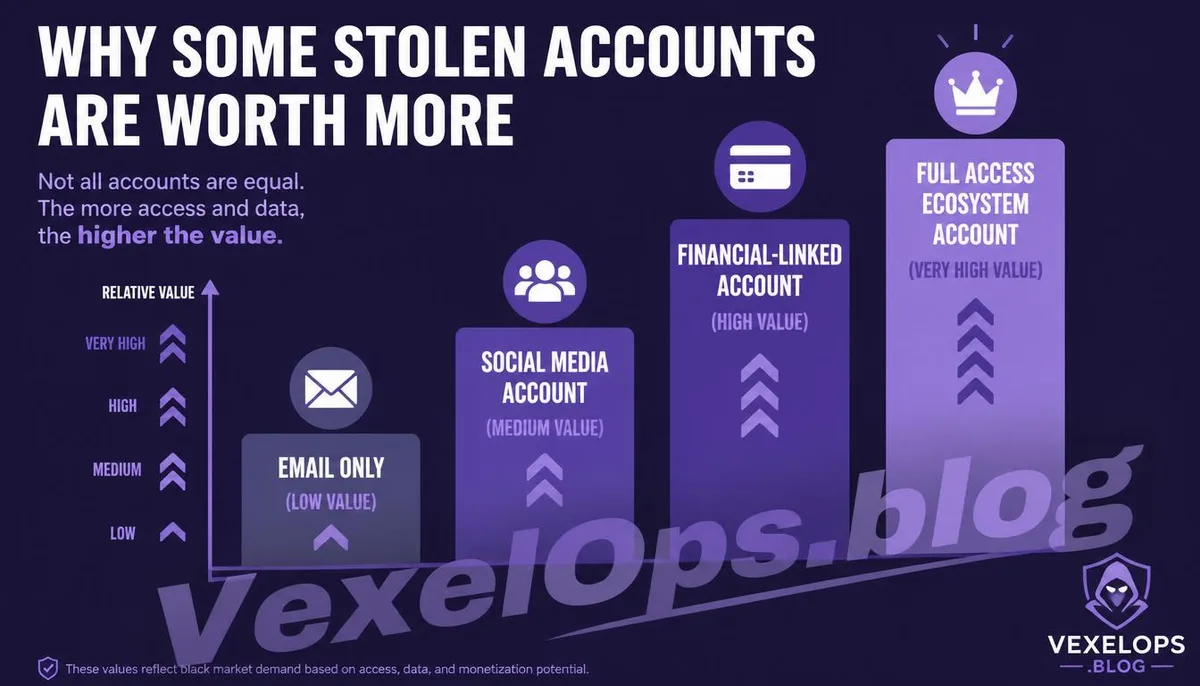
The pricing logic in the black market is generally proportional to the extent to which this information can be utilized. Simple email account passwords, if not linked to other valuable services, usually have a low price because the actions an isolated email can perform are limited. However, if this email is simultaneously a recovery email for several other accounts, its value increases, as it essentially holds the keys to further invade other accounts. The value of social media accounts depends on follower count and account history. An account accumulated over years with a certain number of followers is worth significantly more than a newly registered account, as these accounts are often more convincing when used to send scam messages, and followers generally have a lower wariness of older accounts. Accounts linked to financial services or with payment records, such as shopping platforms storing credit card information or gaming accounts containing virtual assets, significantly increase in price because they can be directly converted into tangible economic benefits.
What Happens to This Information After It's Bought?
Understanding the price is only part of it; it's also crucial to understand the actual uses for which this information is purchased. The most common use is for sending scam messages or phishing links, leveraging the original trust associated with the stolen accounts to send scam content to friends or followers, as the success rate is significantly higher than using entirely new and unfamiliar accounts. Another use is to attempt logins on other platforms, as many people tend to use the same or similar password combinations across different services. A leaked account password set may be used to test logins on email, shopping platforms, or even banking services. Another scenario involves direct use for financial fraud, where if the account itself is tied to a payment method, it may be exploited for unauthorized purchases or transfers.
Common Questions Users Ask About the Black Market for Accounts
How Can I Tell If My Account Information Is Already Circulating on the Black Market?
You can use data breach inquiry tools by inputting your email address to check if it appears in known data breach databases. These tools compare against publicly disclosed breach event lists. If your email is shown to have been associated with a specific breach event, it indicates that this information may have a certain probability of flowing into relevant channels. In this case, you should prioritize changing that email and all accounts using the same password.
Can Account Information Be Recovered or Deleted After It Has Been Sold?
Once information is packaged, sold, and circulated through multiple channels, it is practically challenging to recover or delete it completely. This is why prevention is significantly more important than post-incident handling. If you suspect your account information has been breached, the first actions to take are to change your password immediately, enable two-factor authentication, and check recent login records and authorized device lists to ensure no one else is accessing the account with the leaked information.
Are Average Users' Accounts Really Targeted, or Is It Only Celebrities Who Should Worry?
In most cases, average users' accounts are not individually targeted; rather, they are processed in batches. Black market trading typically involves bulk database transactions, not targeted personal attacks. Because it’s batch processing, it means anyone’s account could potentially be in a breach event database. You shouldn’t think that just because you’re not a celebrity you will not be included; the basic habits of protecting account security are equally important for everyone.
One Key Takeaway: Account information does have a clear pricing logic in the black market; accounts tied to financial information or with a large number of followers are more valuable. However, any leaked account credentials can be exploited in batches. Regularly checking data breach databases and avoiding password reuse are the most practical ways to reduce risk.